
‘A windy day – shelter and support from the trees in Perrett Park. Feeling overwhelmed again and need space. Nomar has been needy, or trying to look after me, not sure… FOG… Intrusion… Little gaps of light poking through the clouds, little bits of space.’
Several times I have come across this FOG thing in my walking notes (above) and I cannot remember where it comes from but it stands for Fear, Obligation, Guilt (I think it was foggy in the park too though). It reminds me of some of my family relationships. It feels very heavy when I think about this, reflected by the weather, and the little bits of light are comforting as I frequent Totterdown’s parks. Balancing light and dark is an ongoing theme in my therapy and with the clients I have seen on placement. This comes into focus at Perrett Park; I often used to go there in the evening with Nomar, after my daughter had gone to sleep, to re-connect with him after work, to feel grounded again. It helped me to have a bit of space at that time, especially if my mind was lingering on clients’ stories as well and I needed to let go of the day. I took pictures of the sunset and the city lights (there is a fantastic view of the city from Perrett Park). I love the slopes in the local parks and as the sun goes down, the tree shadows become elongated, reminding me of how warped memories and thoughts can become if left unchecked.
During one January’s frosty walks I photographed shadows in Arnos Park and also an abandoned pram. It wasn’t really abandoned, the Dad was just further up the park, picking up his dog’s shit, but I left him out of the picture for effect.
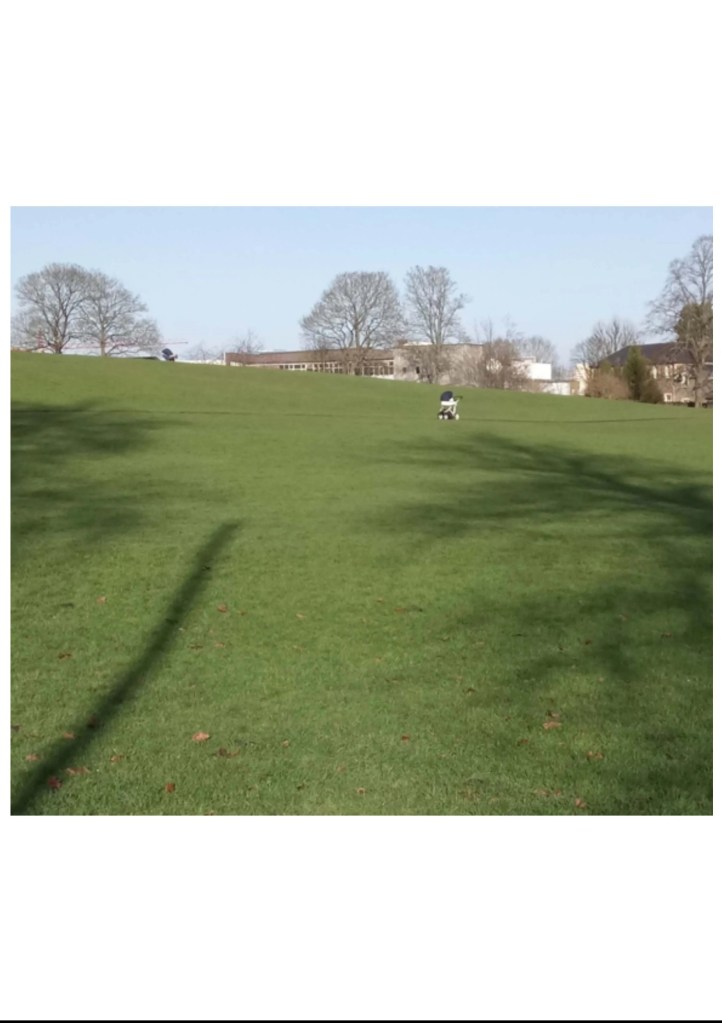
I wonder if the sense of isolation the picture evokes in me feels reminiscent of a similar feeling in childhood and my assumption (perhaps) that I felt emotionally disconnected in some way. Little did I know just how isolating life would become in 2020. Can we experience a sense of self in isolation or can this only be achieved through connecting with others? On the other hand, what we see in others and what we see of ourselves through others can become so distorted and foggy. Yalom (1) has helped me come to a realisation about the significance of an experience I had the following February.
This is what I wrote about the experience at the time:
‘I hear frantic screeching and see two magpies enmeshed together. Fighting or mating? I wonder. This reminds me of our PD group facilitator saying, “are you fighting or fucking? I mean metaphorical fucking of course”. I said ‘metaphorical fucking’ would be a good name for a song or an album. Anyway, I realise that one of the magpies has one foot tangled up in the furry feathers of the other magpie, in the place where its foot should have been. So the second magpie only has one foot. I grab them both in one fast and firm movement (instinctively from my farm days?) over the top of their iridescent wings, and try to assess the situation. Nomar is barking and bouncing around and distressing the birds, so I put them down, tie his lead to a tree, and start again. I manage to ease the tangled feathers off the other bird’s foot, whilst doing so their talons grip my fingers vehemently and their beady black eyes peer up at me. Entangled together like that, they would not have survived I’m guessing. The whole time I feel irritated that I am not focusing on the present moment in that profound experience of freeing those birds, instead I am thinking about one of the 13 toy animals I use in therapy to represent my ‘selves’; the penguin with one foot (my counsellor’s dog chewed off the other foot). The wounded healer (Carl Jung). The survivor?’
Yes, I was reminded of the wounded part of me by the magpie with one foot, although what I had not explored more fully was the enmeshment. Yalom eloquently reflects on an interaction he observed between a long-term client and a fellow consultant,
‘I am persuaded that, in these infatuating first meetings, Dan and the woman mistook what they each saw in the other. They each saw the reflection of their own beseeching, wounded gaze and mistook it for desire and fullness. They were fledglings with broken wings who sought to fly by clasping another broken-winged bird. People who feel empty never heal by merging with another incomplete person. On the contrary, two broken-winged birds coupled into one make for clumsy flight. No amount of patience will help it fly; and, ultimately each must be pried from the other, and wounds separately splinted.’ (1)
There was no opportunity for me to splint the wounds of those two magpies after their independent flights into the trees. Nevertheless, the prising apart of their entanglement gave me a deep sense of satisfaction. It was not clear at first what was happening when they were so caught up with each other, it was distorted, unnerving, I doubted I could do anything to help or even if help was warranted or might be intrusive. I soon realised, of course, that these birds had no way of helping each other and needed to be pried apart to survive. With human relationships, this seems infinitely more complex and difficult to achieve. I have often felt that pull towards, even into, other people’s experience. They are usually people with particularly traumatic backgrounds. I feel an instant, deep connection with some people, although simultaneously a wariness and instinctive sense that this is not good for me. Unfortunately, I have ignored that instinct at times in my past and have had to learn the hard way, by experiencing the helpless dark pit of a gradually fading sense of self.
The most caring and important thing my father and step-mother ever did for me was to help me wake up to a destructive relationship (when I was 19) and disentangle myself from it. My mother then calmly and patiently helped me to clear up the ‘mess’ afterwards – sorting through, cleaning and moving out of my flat – an unpleasant experience emotionally as well as physically. I had started to see a counsellor for the first time in my life (at University) and she suggested I take my time clearing out the flat and notice how I was feeling. I realise now she was encouraging me not to dissociate. This was the very first step in my recovery. I haven’t always felt that my parents were there for me when I needed them, but that time… they saw I was at rock-bottom, they asked if I needed help and I will be forever grateful.
With clients, I ramp up the grounding techniques when I feel the pull. Early on with one client I actually felt myself dissociating slightly during sessions and felt that her huge eyes were sucking me in, engulfing me. I reinforced my awareness of my body against the chair, my feet on the floor, my hands resting on my belly, containing and protecting my sense of space and self. Striving to maintain, as far as possible, solidity in connection. This grounding practice is anchored further during some of my dog walks; I might lean against a large tree for a while, notice the rhythm of my walking, observe the solidness and softness of trees, with the hard branches and the ‘flossy willows’ (pussy willow) as my daughter likes to call them; deliberating over balance and collaboration (rather than co-dependency) in relationships, among humans, and between human and hound.
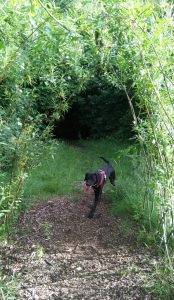
In Victoria Park there is a willow tunnel. I like to walk through it. I consciously enter it from different ends on different days, just as I try to actively consolidate new pathways in my mind. Sometimes Nomar runs through it with me and other times he is off doing his own thing, usually weaving around trees, looking and sniffing for sticks, his tail zigzagging in all directions. We move apart and we come together, with synergy, unspoken (mostly), without effort, like a dance. The willow takes me back to the farm and the old willow tree we had in the garden, which I used to sit under and ‘talk to the fairies’, apparently. It seems I had a relationship with trees from a young age and it is no wonder that I now seek out their containing, awe-inspiring and nourishing comfort. I have begun to bring the more magical aspects of childhood into my therapy, as the grief at leaving the farm lessens.
It feels important now to share some of this, and to begin to think about what I might share about my childhood with my own daughter. I wonder, also, how to start bridging the gap between my somewhat idealised childhood and my current adult life. Much of the pain is in-between. Very little about my childhood has been discussed by my parents since they broke up, at times it feels like it never existed and has taken on a sort of mythical quality. The willow tree in the garden was cut down because the roots were too close to the house, where does that sit in my ‘tangled ball of grief’ (2)?
The first time I lived on my own, at age 18, my drinking problem was escalating. I experienced frightening, intrusive thoughts and images most nights and kept a baseball bat under my pillow. Somehow I got through my A Levels but didn’t achieve my predicted grades and therefore didn’t get onto my chosen degree course. I took a ‘gap year’ which involved staying in Hereford, getting whatever jobs I could, and after work – spending a lot of time in the pub drinking cider, eating pork scratchings and playing pool with older men, with their dogs as witnesses. I was especially fond of ‘Skippy’ the Whippet. I would later visit the 24 hour Tesco close to my flat on the way home from a nightclub. As well as ‘munchies’, I would often buy plants in my drunken and stoned state and I remember once introducing a coconut plant to the willow tree on the roundabout, as I neared my flat. I was with a friend and there was much hilarity generated by this midnight arboreal encounter. At the same time though, and in hindsight of course, something deeper was at play. Trees are considered sacred in many cultures and some humans have a sense that trees are sentient beings, emitting a vibrational energy upon contact, and through their deep roots, carrying powerful grounding energy. Trees represent connection and cycles of life. I pasted an article into my journal a few years ago about the history of Victoria Park (3) and circled the following section,
‘So many trees were planted that in 1907 the Bristol Ratepayers complained about the cost. But the many limes, oak and plane trees have given the park its character, and whenever one has to be felled because of age or disease, people mourn or even protest at their loss.’
This post doesn’t feel finished… I keep coming back to it again and again. I can’t work out how to finish it. Maybe that’s the whole point? Although shouldn’t I be saying this for ‘Unfinished Business’?

© 2021 Psychodography Blog
REFERENCES
- Yalom, I.D. (1991) Love’s Executioner: And Other Tales of Psychotherapy. Penguin.
- H. Norman Wright (2014) Experiencing the Loss of a Family Member. Bethany House, a division of Baker Publishing Group.
- South Bristol Voice (2017) The Story of Victoria Park, 30-33.

 Psychodography