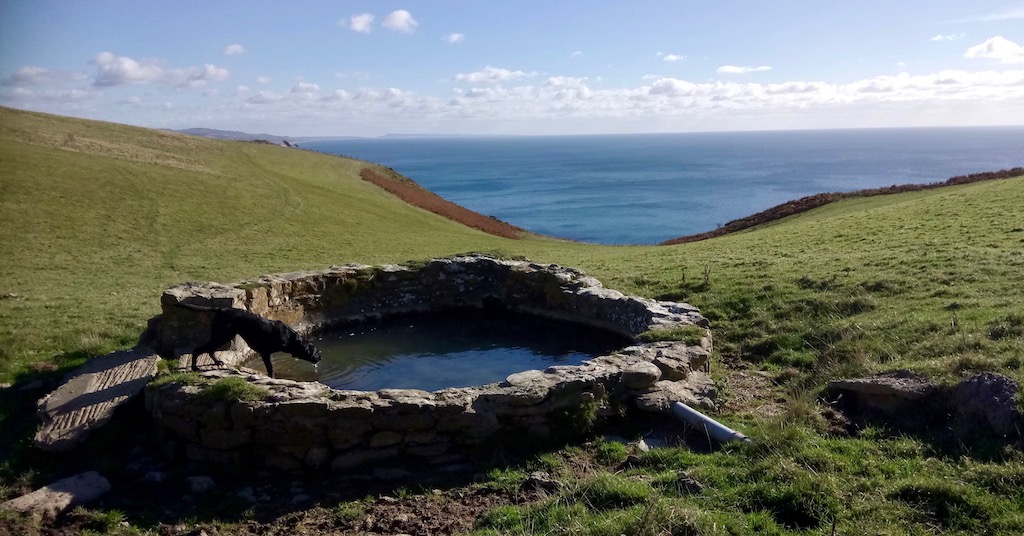
On our walks, Nomar and I ‘move apart and we come together, with synergy, unspoken (mostly), without effort, like a dance’. I feel a profound sense of belonging, I wonder if he does too? Merleau-Ponty, a French phenomenological philosopher, suggested perception plays a foundational role in understanding the world as well as engaging with the world. His outlook was naturalistic in that ‘it sees human beings as integrated into the natural order, as fundamentally belonging to the world…’ (1)
I thought Ashton Court would be my final destination in this story. I found the voice recordings, the walking notes, etc., were detracting from my here-and-now experience, so I decided that was the end. A month later I started again, there was more to say, more to record and listen back to, more to write, more to capture of the experience and cherish and use as powerful reminders of the restorative quality of these walks with my dog. I realised I could do both; a little bit of recording and capturing, but mostly just practising staying present in each moment (2). I grew in confidence, more at peace with myself and my choices, more authentic? Walking further than before I came across a round pool, similar to the ‘magic pool’ I found on the Dorset cliffs into which I could imagine my past, present and future, reflected back at me – so clichéd I know, but that’s what I felt all the same. Radiohead’s album ‘A Moon Shaped Pool’ (3) and the song ‘Present Tense’ kept going round and round in my head at the time.
I continue to explore power and vulnerability in the rich, green, open areas within the city and how this feels in my body, in relation to my surroundings. Coming back to Merleau-Ponty, he emphasised the body as the primary site of knowing the world. I think I know what he meant. The power of movement is an essential antidote to persistent ‘freeze’ response (4) in my trauma recovery and building up muscle strength, which I feel is also an antidote to ‘flop’; one of the less well documented threat responses (5,6,7).
With this sense of power and my anchor [my dog] by my side, I can more deeply tolerate my vulnerability in the world. Just up from the pool, there is a small patch of woodland with a triangle of branches on the ground. I walked along them balancing in a childlike, playful way, and then stood, bold, arms in the air, eyes closed, feeling the power and vulnerability in my body simultaneously. I could hear and feel Nomar close to me, just lying and waiting on the ground and I could keep my eyes closed for as long as I felt like it, no need to check over my shoulder in case of a threat. Safe and secure and free. I imagined being connected to the roots of the dark green trees with silvery-blue threads. Right now as I write this, I have two songs by Timber Timbre playing in my head; ‘Woman’ and ‘Do I have Power?’
Trauma is explained by Kohut (8) as an affect overwhelming the mind’s capacity to maintain its balance. If the seeds of vulnerability are sown early on, due to mis-attunement and lack of empathy, narcissistic injury is likely; a difficulty restoring balance when self-esteem is upset. Consequently, rage is perhaps a breakdown of a child’s ‘innate healthy assertiveness’. It is suggested a child can form a compensatory attachment with an object (or an animal?) and I feel that my assertiveness became embedded in my relationships with animals. As a woman out with my dog I seem able to re-connect with stagnant rage and experiment with moving it through my body and voice, in a way that feels safe for me.
There is something about permission which has been creeping into my thoughts, recordings and notes. I have felt resistant to exploring this. It seems dogs give me permission to seek my own space, guilt free. Playfulness is considered an antidote to guilt, linking to Erikson’s Initiative vs. Guilt stage of development (9). Having finished the counselling diploma several years ago and submitted a shorter version of this story within the constraints of the word limit, I have now taken the initiative to come back to it and give myself permission to continue with the process, just for me. Nomar and I continue with our cemetery, park and river walks, we return to Ashton Court from time to time and I am planning a return to the Jurassic Coast, hopefully with the whole family – obviously as restrictions ease. I notice that I do not feel quite so angry or quite so sad or quite so fearful.
One June I was struck by a sense of softness and stillness. I found myself reflecting on the Woodland Wellbeing group for people affected by Dementia. I was co-facilitating this group at the time along with two incredibly knowledgeable and creative ‘forest ladies’, as I like to call them! I wrote this as I recalled the latest session,
‘yesterday the fairy fluff offered to us from the willow trees softly caressed our faces and hair as if inviting us to stay still and be nourished, attending to each person equally, there is no judgement from the trees. Willow is welcoming to all.’
In the summer months, in Ashton Court and Victoria Park, I often notice the abundance and variation of meadow flowers, the colours, the grasses and birdsong. I delight in watching (Nomar) as he,
‘glides through a shimmering mist in the tall grasses… covered in shiny dew droplets and grass mist and tiny bright green seeds… he has become a pollenator’
Kohut’s endorsement of ‘playful creativeness’ (10) and my focus on experience of the environment seems to mirror my newly evolving psychogeography practice, with its emphasis on playfulness and “drifting” around urban (or sometimes rural) environments. Hart described psychogeography as a ‘slightly stuffy term’ for,
“A whole toy box full of playful, inventive strategies for exploring… just about anything that takes pedestrians off their predictable paths and jolts them into a new awareness of the… landscape.”
(11)
I am on an experimental pursuit of balance between past and present, light and dark, and that of multiple selves encompassing a whole. Clients and counsellors alike are treading out new and unpredictable paths, etching new landscapes in the mind, abating the habitual and dissociative.
There is a simple version and a complex version of this autoethnographic process. The simple version; I love going for walks and spending time with my dog and this is largely my only respite at this stage in my life. The complex version I hope I have gone some way to clarifying in the other sections. For this expedition I have had to engage the trust in my feet, the courage in my belly and the hope in my heart, to go out into the world and put the past behind me. My mind, my imagination, have also become integral to this process. Much of this is summed up nicely in my favourite of my children’s story books, ‘Augustus and His Smile’ by Catherine Rayner (12); where a sad tiger roams the world in search of his smile.
My counsellor and I have often talked about how wonderfully present children are, as well as dogs. I love my daughter’s certainty about the things she likes; ‘I’m climbing and I do like it’ with the emphasis on the ‘do’. Through becoming more present with myself, others and the world, I am moving beyond trauma, beyond grief and beyond ambivalence, towards a more solid sense of identity and belonging.
It greatly disturbed me to have my gender equality bubble burst upon becoming a mother/parent. The pervasive stereotypes and expectations based on gender; of both parents and children, has been shocking to me. Surely we’ve moved past this, I thought.
Simply being in the world with my dog when I’m not fitting into some kind of role, is when I feel truly settled in myself. I am a person, I am a woman and I belong in the world. I have friends and family; animal and human alike. I am a wife AND a life partner. I am a mother AND a co-parent. I have been scared, lonely, trapped and in pain and right now I am safe, loved and free, and I am grateful. I am becoming a counsellor, I am a counsellor, and I do like it.
© 2021 Psychodography Blog
REFERENCES
- Moran, D. (2000) Introduction to Phenomenology. New York: Routledge.
- Stern, D. (2004) The Present Moment in Psychotherapy and Everyday Life. W.W. Norton. New York.
- Radiohead (2016) A Moon Shaped Pool. XL.
- Rothschild, B. (2010) 8 Keys to Safe Trauma Recovery: Take-charge Strategies to Empower Your Healing. W.W. Norton. New York. London.
- Ogden, P. & Minton, K. (2000) Sensorimotor psychotherapy: one method for processing traumatic memory. Traumatology, VI(3), article 3.
- Porges, S. (1995) Orienting in a defensive world: mammilian modifications of our evolutionary heritage. A polyvagal theory. Psychophysiology, 32, 301-318.
- Porges, S. (2004) Neuroception: a subconscious system for detecting threats and safety. Zero to three, May 2004, 19-24.
- Kohut, H. (1972) Thoughts on narcissism and narcissistic rage. Psychoanal. Study Child 27:360-399.
- Erikson, E. (1998). The life cycle completed. New York: Norton.
- Siegel, A. (1996) Heinz Kohut and the Psychology of the Self (Makers of Modern Psychotherapy). New York: Routledge.
- Hart, J. (2004) A New Way of Walking. Retrieved from http://www.utne.com/community/a-new-way-of-walking
- Rayner, C. (2006) Augustus and His Smile. Magi Publications: London.

 Psychodography