Please proceed with caution if you come across this and have had some similar experiences to those described below – I was triggered for a long time by some of the same and similar words to those used in this post, which was why I didn’t include those words in much of my writing, until recently. This is where I make clear and plain some of the story that was missing (but alluded to) before. If this causes anyone pain or distress, I am very sorry. Please get in touch if you need to.
This process started over 5 years ago. Why then, did I choose to make it public at the end of 2020? Because Layla F Saad said,
‘Introversion is not an excuse to stay in white silence… You can be an introvert and have powerful conversations. You can be an introvert and use writing to disrupt white supremacy. You can be an introvert and show up to protest marches. You do not have to be the loudest voice. But you do need to use your voice.’ (1)
Since starting this process in 2016 for my research dissertation for a Counselling Diploma, it has never felt finished. Those were simpler times, although I did not know that then and by no means did life feel simple. Perhaps these are simpler times; a global virus spreading like wild fire, while wild fire destroys much of Australia. Perhaps this is all to be expected given the climate emergency. Perhaps, perhaps, perhaps… (it has just occurred to me how often I use this word and I have searched back through the original document and tried to find alternatives to my ambivalent perhapses).
I have dipped in and out of this ‘project’ over the years and finally came back to it in 2020 with the intention of finishing it and figuring out what, if anything, to do with it. During the past 4 years I have had EMDR (Eye Movement Desensitization and Reprocessing) therapy, I have reported the rape that happened to me at age 15, a close friend tragically died from bowel cancer, I had my second child, a son, who was born on exactly the 1st anniversary of our friend’s death. Meanwhile, global tensions rise, racial inequality intensifies and we enter the age of coronavirus. I recently returned to the article Walking Together (2), one of the main early influences for ‘Psychodography’. I was particularly drawn to this;
‘It seems to me that therapy cannot afford to ignore social justice. Psychogeography offers a radical, subversive, challenging critique of space that psychotherapy can benefit from…As Psychotherapists and counsellors we are engaged in the vital challenge to understand and communicate at depth with different cultures, races, and experiences…In our thinking too, we need to cross boundaries.’
I doubt there’s anything radical or subversive about my walking, thinking or writing… it’s early days still. Then again, self-doubt is something I continually battle with.
Within the constraints of our current circumstances i.e. global pandemic, what I’m trying to focus on the most is my intention, whilst identifying what there is yet to attend to in my own personal processing which may be holding me back, still. In terms of trauma recovery, I know I’m on the other side of the tunnel… I know this because there’s a circle sculpture in Arnos Vale Cemetery and I used to stand at a distance from it and stare at it, not through it, and sort of zone out at the same time. Now though, I approach it from the other side, with purpose and clarity. I wrote this sometime in the summer,
‘The circle. I can walk straight up to it from behind, bold as brass, and look straight through to the other side – I know what this means but I don’t suppose others will…’
I also know it because I no longer get flashbacks or unpleasant triggers from listening to certain types of news. I can talk about what happened without dissociating or retreating into shame. I guess this part is probably easier for people to get their heads around than the circle/tunnel thing. At the start of EMDR, the therapist said something like, ‘do you want to focus on the first, the worst or the most recent?’ (traumatic memory). The worst is now no longer so active in my mind, it’s further away, faded, as any memory should be. Nevertheless, I think I have to keep working on it (the recovery I mean), like a muscle, and never get complacent. I feel the need to put it somewhere to keep an eye on it, hence part of the reason why I have put it here.
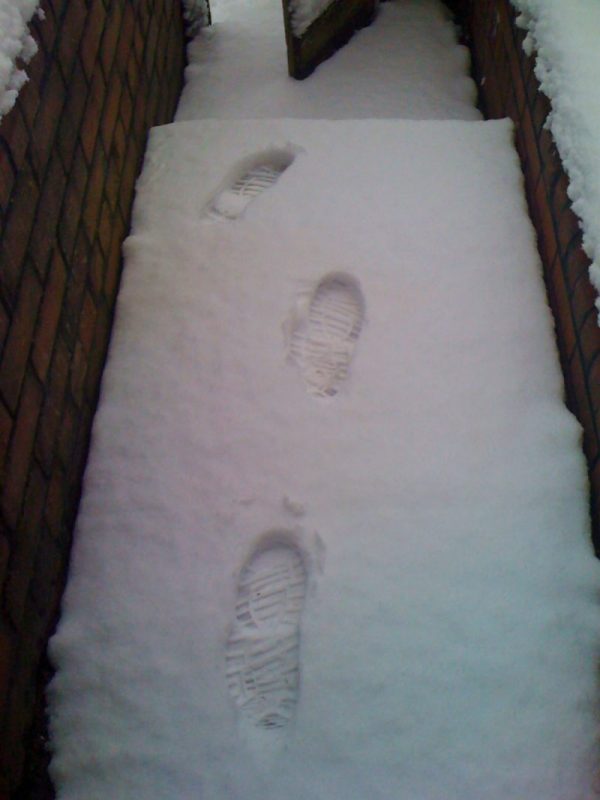
It feels significant that I am finishing off this post in February too (only just), as it was in February that the rape happened, 23 years ago. I’ve often struggled with February and didn’t understand why for a long time. I mean, it’s not an easy month anyway, even without a lockdown (or a rape; tragically for many people, they have to endure both) – not quite spring, not quite light enough, not quite warm enough. The weather still feels harsh at times, resources are low from nearly 3 months of winter. This February, I’ve tried to notice warmth and softness wherever I can. The captivating gentle flurries and soft dusting of snow – if I stare at the snow falling for long enough, it takes on a sort of magical, unreal quality. Occasionally (childcare allowing), I have a warm bath when I get home, then wrap myself up in a blanket. And every evening I still light a candle of course. Perhaps each candle is for each person being abused around the world, I’m going to need a lot of candles! What does it mean when I blow the candle out?
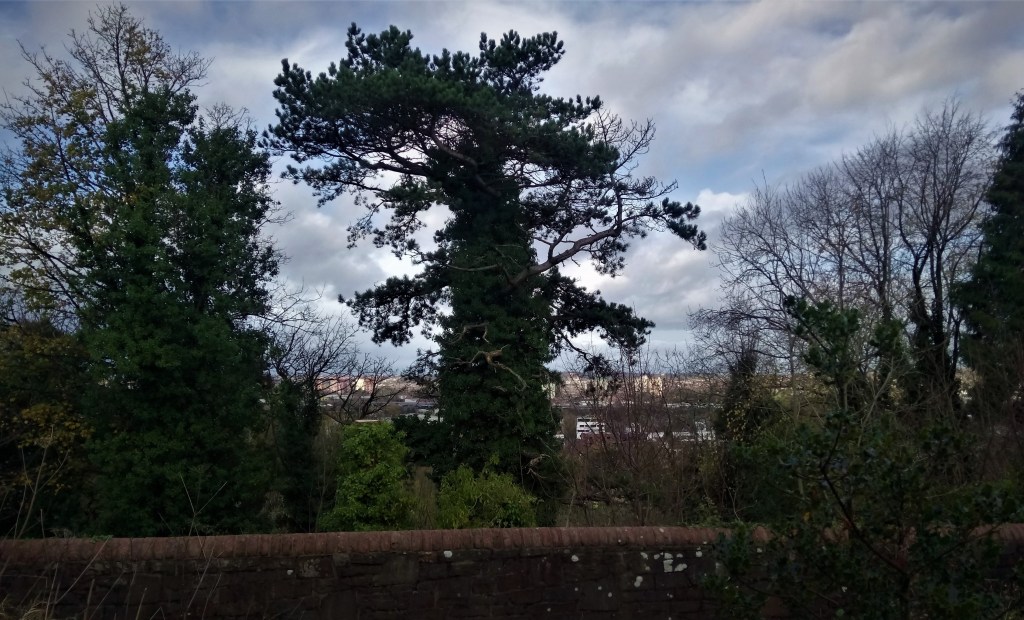
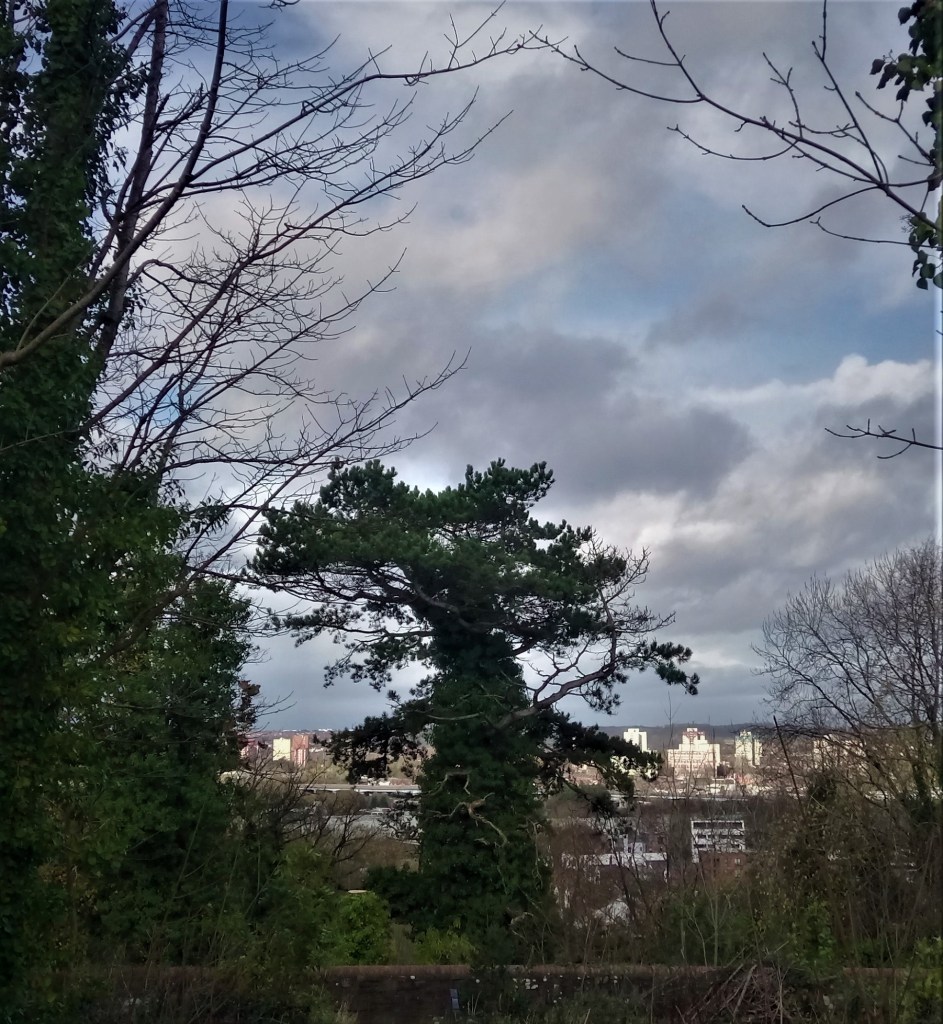
I took a photo of what I now like to call the woolly tree; it’s a very tall tree engulfed in ivy, it looks like it has a massive body warmer on! I found myself gazing beyond the woolly tree, into the distance, at the tower blocks. I wondered what it might be like in lockdown to not have a garden or even a safe green space close by.
To say a bit about the EMDR and the rape – I did not want to include this within the main story because the story is not about the rape, it is about self-care, about the anti-dotes to rape trauma (for me). Yet, it feels important to share something about EMDR, in case it’s helpful to others who might benefit from it, and it doesn’t make sense to mention EMDR without mentioning what I was having it for. EMDR was discovered by Francine Shapiro (3) while she was walking in the park (I like to think she had a dog with her too); this was one of the reasons it appealed to me. The aim was to push the trauma ‘through the tunnel’ and come out the other side with the memory processed, as all memories should be, and no longer lurking in the amygdala; ready to pounce at any given moment at the slightest perceived threat, the slightest mention of a similar experience on the news or by a colleague or client, the slightest re-visiting of the trauma with a therapist or in a personal development/therapy group.
Thankfully, the memory was indeed processed and began to fade. It was no longer right up in my face when I closed my eyes in the shower, there was no longer a contaminated feeling within me. I will admit, and a gentle warning to others thinking of trying it, it was unpleasant. The kinds of things that my consciousness needed to do to the perpetrator in order to break the fixed images and hypo-arousal; experiment with alternative realities that at the time were not possible… these things were unpleasant, violent, powerful, disturbing and …necessary, to free that ‘freeze’ and ‘flop’ response (please see ‘Magic Pool’). Doing this ‘work’ with a recommended and very experienced therapist, and having done the many years of ‘groundwork’ that preceded it (including this project), I was finally able to talk about the event with the police without becoming de-stabilised. Finally able to find some kind of closure.
Choosing to embark on a counselling diploma (and further unearthing lurking traumas) whilst looking after a very young child, may have been foolish. I had to be very careful and patient around how and when I was going to process such experiences and be able to continue functioning as a parent day after day. Maybe it took longer than it otherwise would have, but in that process I have learnt invaluable grounding tools that will stay with me for the rest of my life. The worst trauma had already been unearthed, I suspect mostly by childbirth (I’ve since heard that this can be quite common – one of the many unfair paradoxes of life; a beautiful bright baby is born and at the very same time, our most hidden darkness emerges from the depths).
It wasn’t a sudden thing, it was a gradual process, amplified I’m sure by sleep deprivation and lack of space/time for myself (‘a perfect storm’ e.g. Mothers on the Edge; 4). Thankfully, it wasn’t quite ‘a perfect storm’ for me, but it was stormy. Flashbacks from the trauma were becoming increasingly intrusive and frequent. So what better time, i supposed, to try to resolve it than during a supportive and safe counselling training course and ongoing therapy, a time when my support network was bigger and safer than it ever had been. I was being held by a huge container (e.g Bion, 5) of compassionate people.
The choice to report it was in the hope of reaching some kind of closure and because finally, 20 years after the event, I was able to cope with doing such a thing. I did not feel I could live the rest of my life with the knowledge that I had never reported a very serious and by its nature, very violent, crime that was inflicted upon me as a teenage child. I did it for the childhood that abruptly came to an end and for the woman I have struggled to become. I did it for my daughter and the woman she will become (and now, for my son and the man he will become). I also did it in case there was even the slimmest of chances that it might link to other, similar crimes, committed by the perpetrator. Of course this did not happen (as far as I’m aware) and even to this day a residue of guilt and shame remains that I did not go to the police at the time or even tell my parents what had happened. And then I remind myself… it was a different time, a different culture, it happened in a different country where I did not speak the language and where the age of consent was 14 and I may not have been believed that I had said ‘NO’.
Nevertheless, I did not even understand I was child at the time, and I was still reeling with hurt and anger about my father leaving our family the year before. The holiday was supposed to help us re-connect. Instead, I was bought alcoholic drinks in a bar, I was raped by a man more than twice my age, my father was searching for me all night and the next day he had an accident (which I witnessed), leaving him with a fractured spine and wearing a body cast for 6 months. The complex interweaving of these two traumas happening so close together and both feeling, for a long time, like my fault – caused my need for help and recovery to plunge down into the depths and not resurface for over 10 years; during which time I struggled with relationship problems, alcohol dependence, depression and anxiety, PTSD symptoms, irritable bowel syndrome, psoriasis and chronic urinary tract infections. I don’t know if all or any of these ‘symptoms’ were linked to the rape trauma, and/or other events and experiences in my life. What I do know is that now, ALL of them have improved.
Now that I’ve got here, I’m not sure what to do with my recovery next. Perhaps this relates to Babette Rothschild’s ‘KEY 8: Make Lemonade’ (6). I hope I have done a bit of this already in my counselling work. I want to do more. Michaela Coel’s bold and eloquent words in ‘I May Destroy You’ may help demonstrate what I mean (below). I had already decided to refer to this mighty quote and now it feels all the more important, after the show was unfathomably snubbed by the Golden Globes,
“Do I actually know what it is to be a woman struggling? A little rape in the mouth is a walk in the park when other girls are currently being stoned to death for having mobile phones, are bleeding to death after genital mutilation, are looking at a womb irreparably destroyed by militiers systematically raping them during times of civil conflict and war. Are these facts a humbling reminder not to be so loud about my experiences, or are they a reminder to shout, can my shout help their silent screams?”
(7)
Maybe it goes without saying, it wasn’t exclusively a rape in the mouth (I don’t think it was for Michaela’s character either, but I see her reasons for putting it this way). Nor, however, was it any of the other atrocities included above. Yet, answerless questions have often echoed around my head… How bad was my trauma? How bad was my trauma in the context of being white, middle-class, privileged? Perhaps the guilt and shame and silence and passivity and ambivalence… I was paralysed by for such a long time, go much much deeper than I first thought.
‘Imagine a world where what women need rolls off the tongue with ease, and we no longer remember that there was a time when this conversation didn’t exist’
(8)
The conversation still does not exist for many women. I intend to move past my personal experiences, continue to crack open my toxic ‘learned silence’ (9) and find a voice to express the wider injustices, cruelties and catastrophes, which unquestionably deserve a torrent of shouts.
It is time to ‘show up’ (1) for others and not just primarily other white women – as I did at a Women’s march after Trump’s inauguration, but failed to show up for the BLM march in my home city last year. There were many excuses not to go – the virus, the baby… and in hindsight I wonder if I thought it wasn’t my struggle. No it’s not my struggle, but it is my responsibility, I see that now. I get it. Or at least I’m closer to getting it than I was a few years ago. I also get it that this learning will be a lifelong challenge.
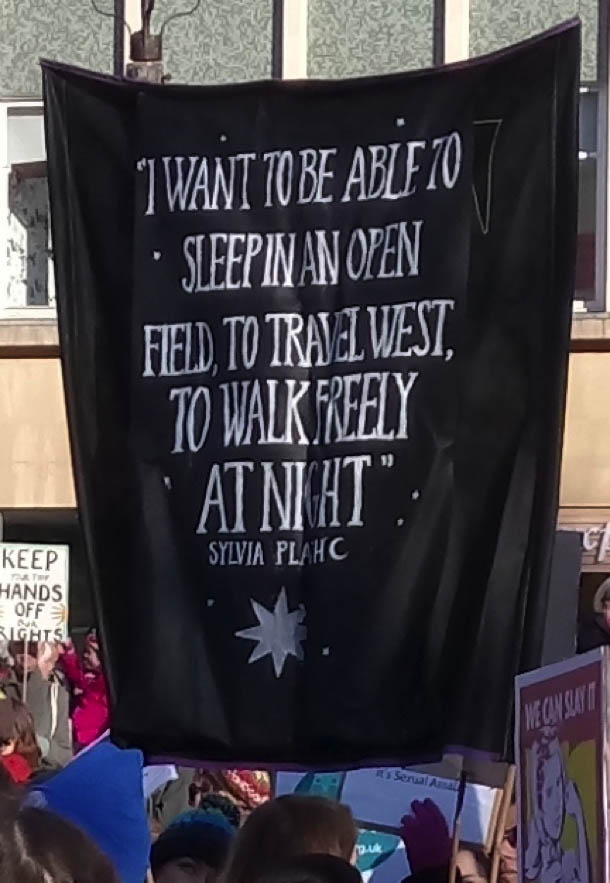
This (above; 10) is what I was more focused on at the time of the Women’s march – what I wanted… to feel free from trauma and threat. To feel unconstrained by it. This seems irrelevant now in our new lockdown lives and it’s all relative anyway right? Maybe this desire will return one day and maybe (I seem to have swapped ‘perhaps’ for ‘maybe’) I’ll go and fly that kite on Chesil Beach, as was my intention after my weekend trip to the Dorset Coast with my dog (please see ‘The Experiment’). I do have the freedom to make that choice. In the meantime, other priorities feel more pressing.
This is my first ‘step out’ of my comfort zone with regards to confronting my white privilege and starting to try to articulate my understanding, with the help of the wise and bold words of women (and men) whom I admire; that I cannot compare my struggles with all women, that it is my white responsibility to sort my own shit out and reach out to others… ALL others. I have so much more to learn about how to turn my silent rage into more ‘eloquent rage’, such as;
“Real radicalism implores us to tell the whole ugly truth, even when it is inconvenient. To own the hurt and the pain. To own our shit, too. To think about it systemically and collectively, but never to diminish the import of the trauma.”
(11)
It took me over half of my life to even begin to take this risk. I don’t want to waste any more time, yet frustratingly… forbearingly… I know I need to tread carefully. I intend to one day (soon, hopefully) add a photo to this blog from a BLM or other anti-racism march, at the very least. My intention for 2021 though is to keep walking, keep writing and keep learning.
© 2021 Psychodography Blog
REFERENCES
- Saad, L. (2020) Me and White Supremacy: How to Recognise Your Privilege, Combat Racism and Change the World. Sourcebooks.
- Rose, C. (2016) Walking Together, Therapy Today, 22-25.
- Shapiro, F. (1989). Efficacy of the eye movement desensitization procedure in the treatment of traumatic memories. Journal of Traumatic Stress Studies, 2, 199–223.
- Theroux, L. & Casebow, M. (Director) (2019) Mothers on the Edge. BBC Two.
- Bion, W. (1962). Learning From Experience. London: Karnac Books.
- Rothschild, B. (2010) 8 Keys to Safe Trauma Recovery: Take-charge Strategies to Empower Your Healing. W.W. Norton. New York. London.
- I May Destroy You (2020), directed by Sam Miller, Michaela Coel. BBC One, HBO.
- Hasseldine, R. (2017) The Mother-Daughter Puzzle: A New Generational Understanding of the Mother-Daughter Relationship . Women’s Bookshelf Publishing.
- Hasseldine, R. (2007) The Silent Female Scream. Women’s Bookshelf Publishing.
- Plath, S. (2000) The Unabridged Journals of Sylvia Plath, edited by Karen V. Kukil. Anchor.
- Cooper, B. (2019) Eloquent Rage: A Black Feminist Discovers Her Superpower. St Martin’s Press.

 Psychodography