Category: Blog

  • Mild Mild West

    Mild Mild West

    Phone notes 2020:

    Coronavirus…

    April 5th (brother’s 40th)

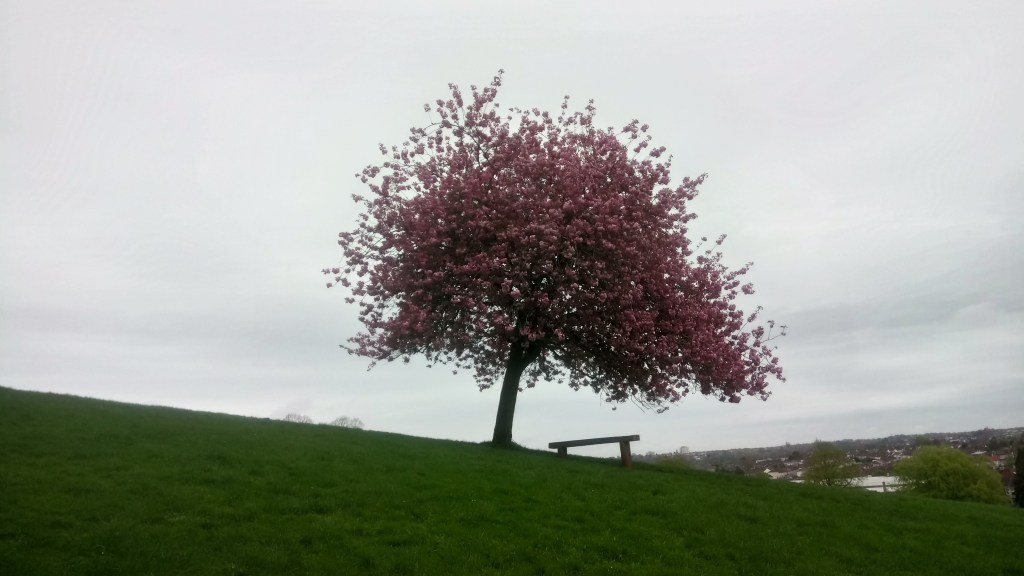
    Looking at pink tree in Arnos (park)

    Yesterday went to Callington Rd Nature Reserve, walked fast away from home, really needed that!

    I later wrote in my journal about this being the first proper walk we had, just my dog and me, as restrictions eased towards the end of the first lockdown. I was re-entering a forever changed world and also re-entering the world as my second child transitioned from baby to toddler and I could start to find myself again, but during such altered, awkward times. I felt such a dilemma when I reached some narrow steps and thought, ‘how do I socially distance here? What if someone comes?’ and gazing into the distance at the hills, trees, pining to be out of the city where I had felt trapped for months in full-time childcare exhaustion; yearning for space, the horizon, a cleansing forest

    Met a small snake

    Was thinking about how to start a story, vignette, whatever it is I’m writing…

    Place + event (e.g. Snake)

    Or Place + feeling (e.g. Freedom, space, escape, movement)

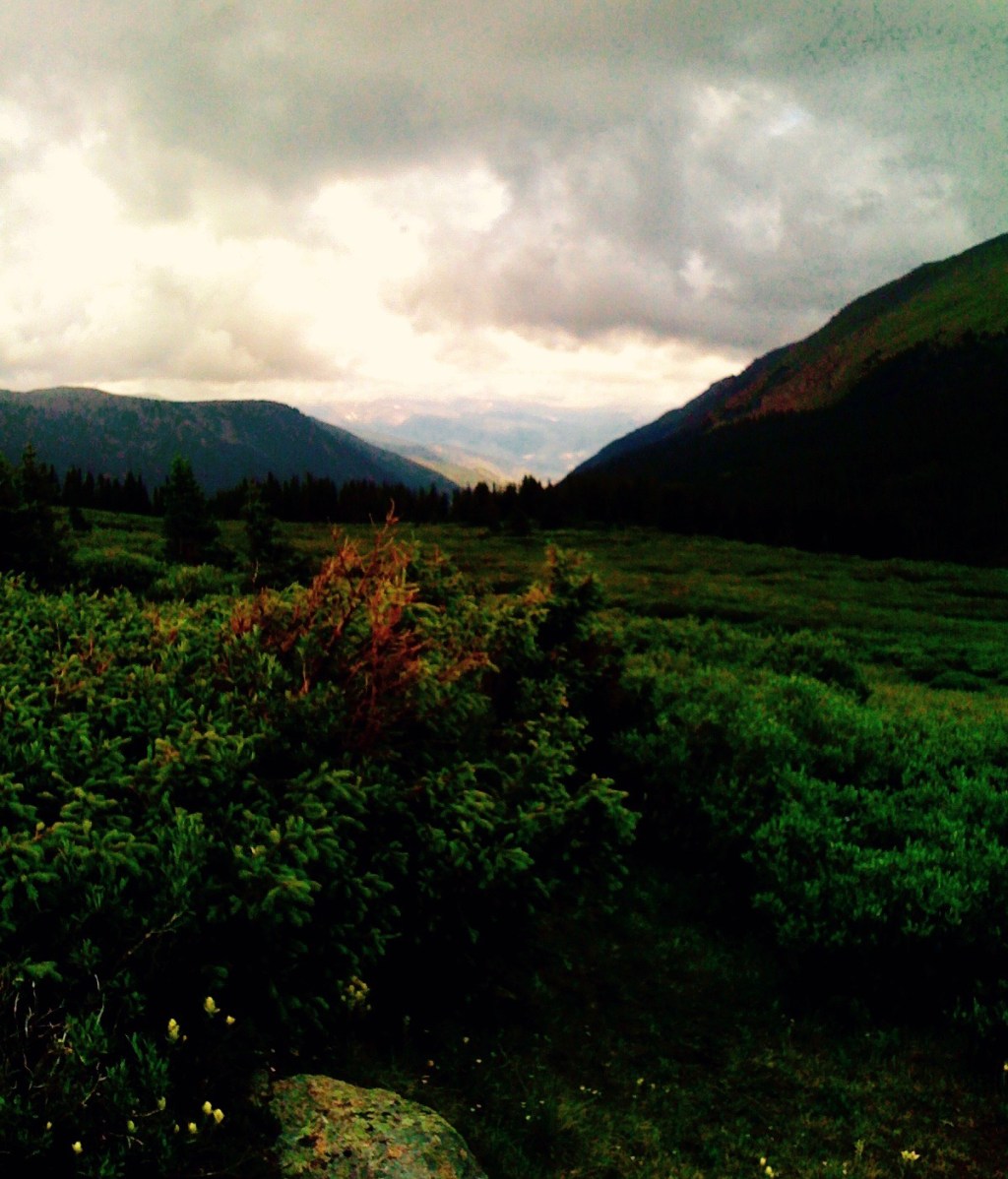
    Or Place + memory (e.g. Jurassic cliffs, hiking & riding in Colorado)
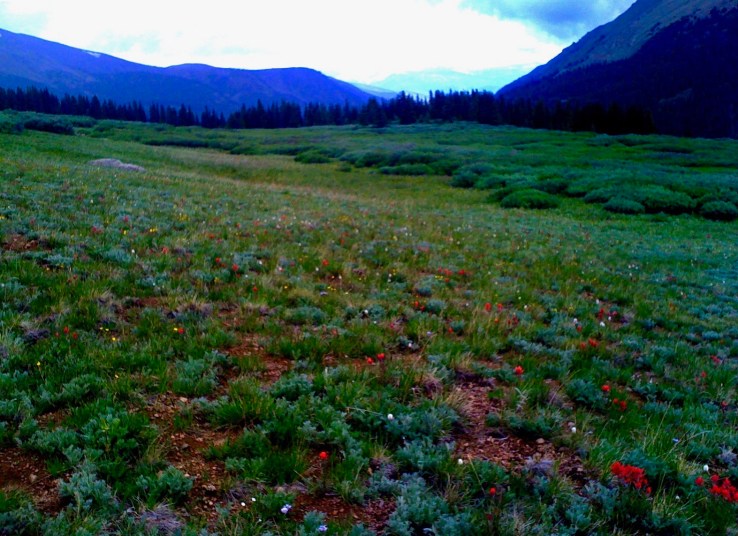
    I always start with place!

    Found myself naming things yesterday – line of tall trees, forgetmenots, hills, etc. (grounding)

    June – restrictions easing

    The cemetery is open, this is the most joyful thing that has happened for ages, ironically. This is where I process, this is where I feel safe, can walk for ages and still be close to home, winding this way and that, it doesn’t matter if the baby kicks off or does a poo or something

    Don’t even care that it’s raining

    It’s wonderful

    There are tadpoles in the pond

    I miss my dog, the two go hand in hand somehow (the cemetery and the dog – he was having a holiday in the countryside)

    Cuckoo

    13th Nov 2020

    2nd lockdown – not like the first

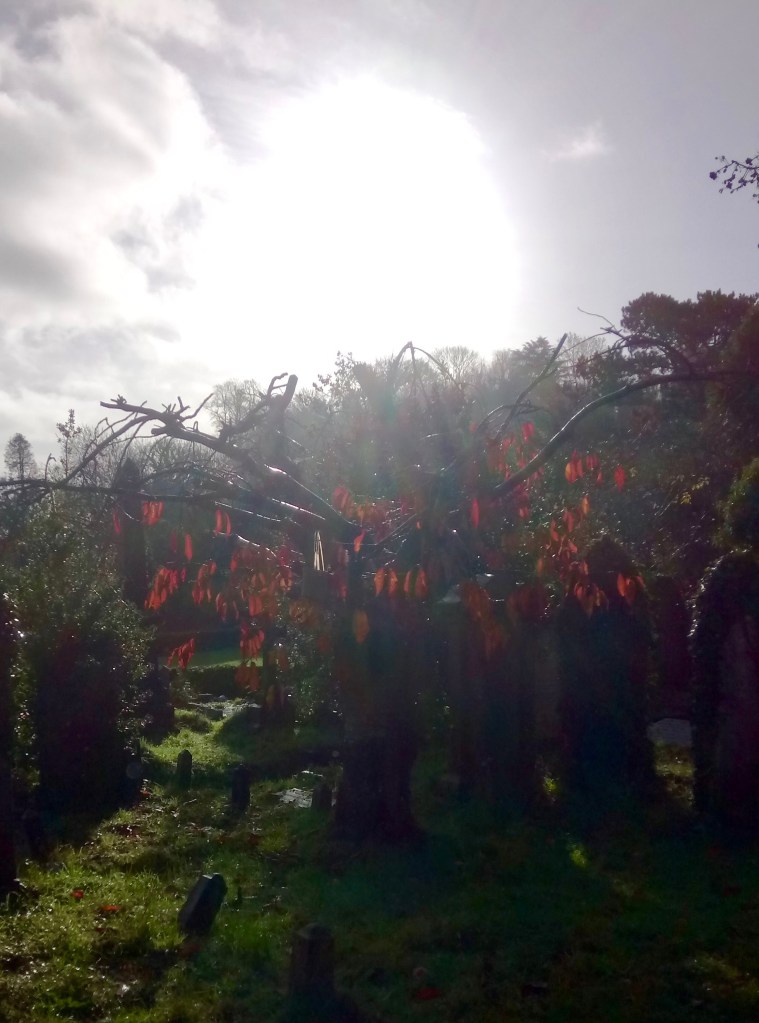
    Magical mizzle in the sun and red leaf tree

    Talking to people…

    It’s about keeping momentum going and not giving in to apathy
    15th Nov

    Nomar (he’s back!)

    Am I healed? Far from it, I have to work it like a muscle and never get complacent. However, the ‘worst’ traumatic memory is no longer right up in my face when I close my eyes, it’s further away, faded, as any memory should be…

    Shapesthree trees, semi circle of trees, curve in the road, triangle roofs

    Music is the next best thing to dog walking – couldn’t take Nomar into hospital with me for birth of second child (or the first, obviously) so the music I chose reminded me of trees, horses… e.g. The Cure (A Forest)

    Walks in lockdown6 year old talking my ears off, 1 year old tugging at my clothes or dipping snacks in a muddy puddle and then into his mouth, bored Nomar disappearing into bushes and emerging with various disgusting trophies, me – stressed, tired, hungry, thirsty, needing a wee, muddy, craving adult company… while some days are haunting me, others were real gems – early summer evening sitting in the park sketching trees with my daughter, Nomar sniffing around in the early evening glow, relaxed and free.

    Looking at tower blocks from a green space, thinking about people who don’t have gardens or parks/green spaces nearby…
    30th Dec

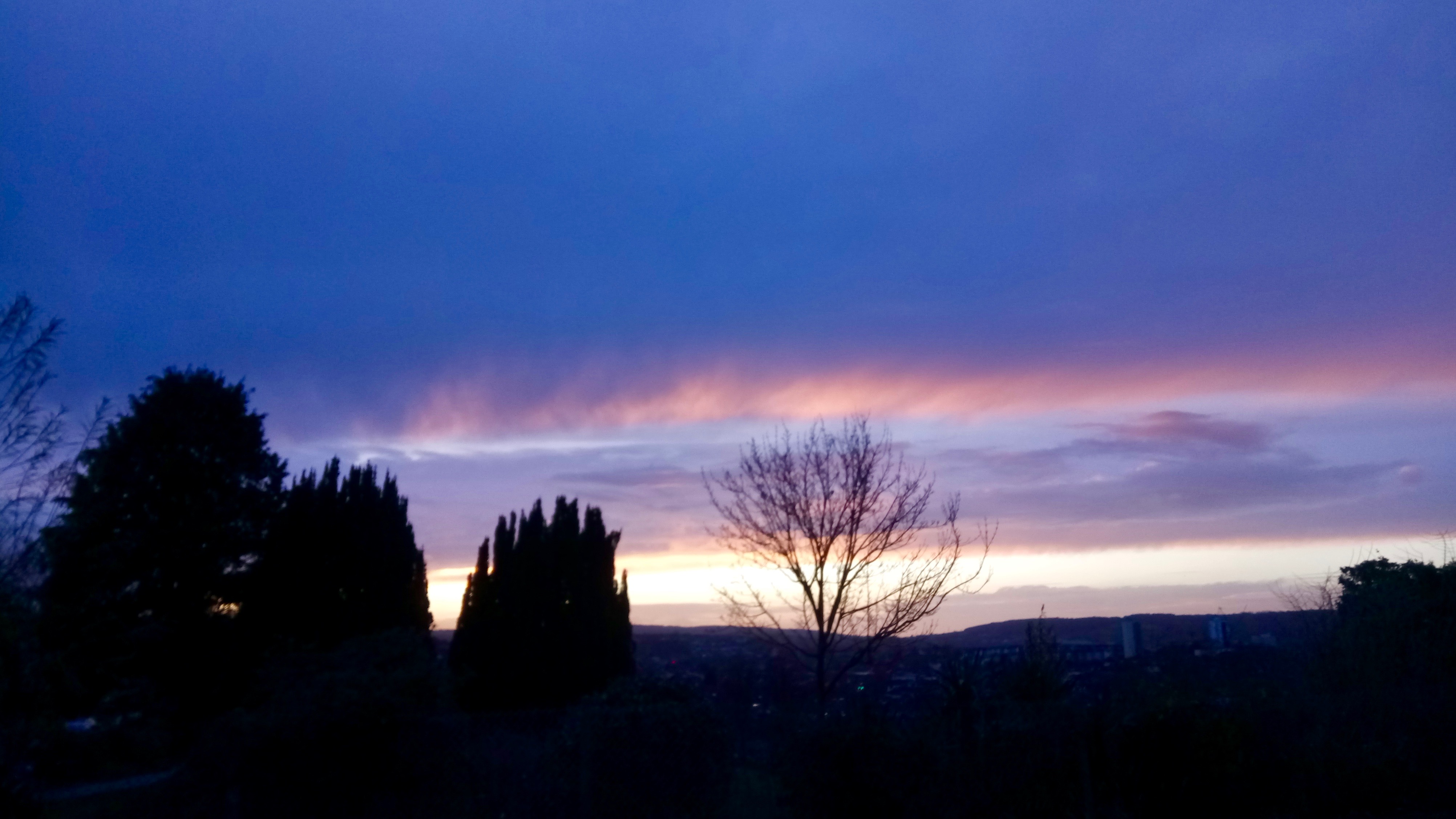
    Nearly the end of 2020, will 2021 be any better? Not at first that’s for sure. Robin singing… me watching (then flew off when I stopped), neutral, until teens play music – I instantly felt sad – it’s people who attribute emotion to everything, nature is a welcome neutral break, it helps just to be present and notice…

    June 2021

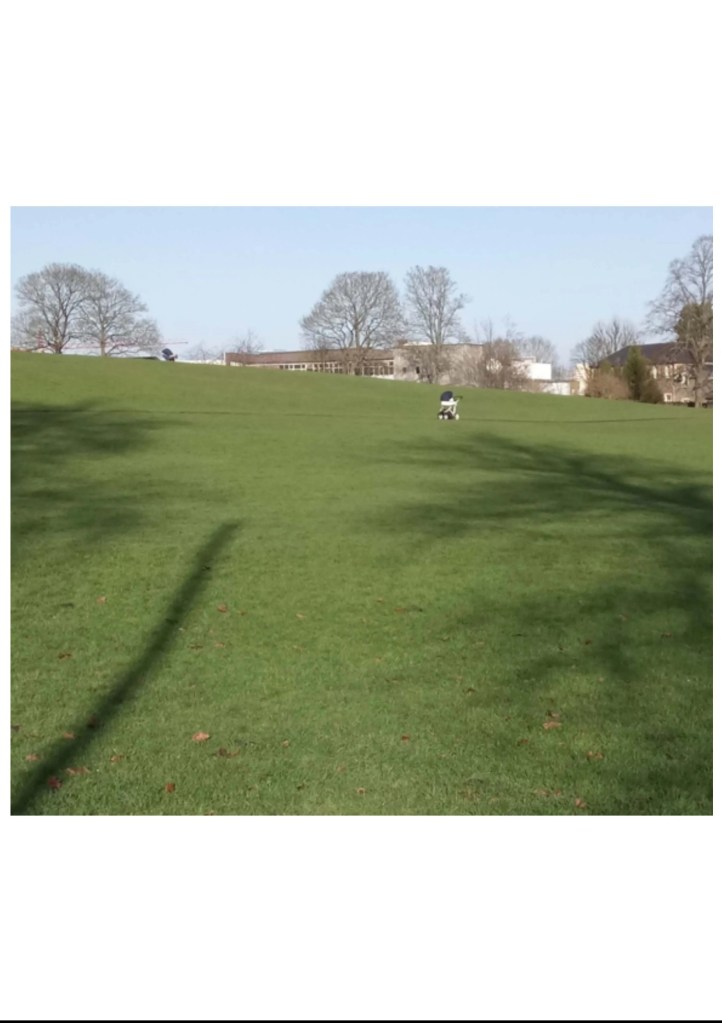
    Pram picture (please see ‘Fog & Willow’)... little did I know how isolating life would become in 2020

    Trying to capture summer tree, a gateway back into this process

    (I know this is a very lazy blog post by the way, I’ve had writer’s block for nearly a year! I needed a way to get back in, so I’m starting by just copying out my phone notes diary from the start of the pandemic, hoping it will ignite some kind of flow of writing again)

    I want and need… (this is what my toddler says and what I don’t say)

    Wales (in Llan-by-the-dog-eye, or however it’s spelt)

    Laburnum trees and multicoloured hedgerows – wonder in diversity Daydreaming about being somewhere else, yearning for something ‘beyond’ vs noticing what’s on the doorstep – the challenges of being still and present and content just with what is… acceptance… I’ve been a long way from acceptance lately, I have often been ‘elsewhere’, (while my children and job demand me to be ever present) – in the hypothetical catastrophic future, or the glimpses of idealised past. Right now I really need acceptance, really want and need it, for myself. To get back to the basics, get all the old tools out of the box and probably source new ones too – a mindful meander with my dog, pushing toddler in the buggy for his nap time, feeling the soft spongy comfort in the moss, looking up at the patterns in the leaves with the gentle sun shining through, hearing the whispers in the breeze, breathing in the earthy scents of delicate dew on meadow grass, musty dried leaves, musk of cows in a neighbouring field. I don’t need to go far, to strain myself or try to achieve anything in particular.

    I cannot ignore though, the distant aeroplane and the resigned resentment that I am not on it, not visiting the half of my family I haven’t seen for nearly 2 years and the somewhat hypothetical, yet fairly likely, nagging worry that there isn’t much time left to spend with my poorly father. His 9 lives are running out. And I always felt I didn’t have enough time with him, that he didn’t give enough of himself to me, even when he was there. And I have to accept that too, and that there is nothing I can do about it.

    What is it that’s so special about being with another ‘being’ (i.e. my dog) in silence. I’m going much slower than he would choose, yet he waits for me, does a bit of noticing of the immediate surroundings too – sniffing the abundant air (which of course is a much more intense experience for a hound), feeling the difference in the grassy, mossy bank on his feet vs the gravelly track, hearing the chittering birds and distant lawn mower (I assume). Then he lies down and looks back for me while I write these notes… he doesn’t utter a sound, not a grumble, no impatient sigh. He just waits.

    I guess I didn’t have writer’s block that day!

    I wanted to add photos of the forest in Wales and the dogs playing, from my first trip away from home after the pandemic started. Looking for these photos has added to the delay in getting this blog post done. I can’t find them, I have to accept it. As well as the forest and the dogs playing (Nomar and his Welsh friend), I was photographing obstacles and barriers; fences, big branches, gates, telegraph cables. I think this was in response to the gargantuan obstacle that is the pandemic and having felt trapped for months. I started thinking about obstacles to connection too and the Social Engagement System. I came across this from the blog “Don’t Try This Alone”, by Kathy Brous (1):

    ‘One way to get people back out of dissociation, aka freeze — aka trauma — says Porges, is to surround them with friendly mammals, and stimulate their mammalian social engagement systems to come back on line.  He gives the fascinating example of play. “Real play, is not playing with a ‘Game Boy’ or computer; it is not solitary,” Porges says. “Play requires social interaction  using face-to-face.”  Notice how the two dogs above are looking each other in the eye’, Brous refers to a photo included in the post and goes on to explain,

    ‘Play requires an ability to mobilize with the sympathetic nervous system and then to down-regulate the sympathetic excitation, using face-to-face social interaction and the social engagement system.  I have two little dogs; they chase each other, and nip. Then one will turn around to look at the other, a face-to-face interaction to ensure that biting was play and not aggression. In play, he says, we practice using our fight/flight systems properly – but we also practice to “diffuse them with social engagement.  So play requires face-to-face interactions. We see this in virtually all mammals.” (Porges)

    Perhaps the obstacles I was perceiving everywhere reflected the felt barriers to playfulness and social engagement, due to the stifling Covid restrictions. I recommend reading what Kohut and Winnicott had to say about playfulness (mentioned in some of my older posts). I also found it so very useful to read Porges’ article ‘The Covid-19 Pandemic is a Paradoxical Challenge to Our Nervous System…’ (2), which offers an explanation for how;

    ‘…the crisis elicits threat-related responses, disrupts our capacity to regulate our behavioral and emotional states, interferes with our optimism, and compromises our ability to trust and feel safe with another.’

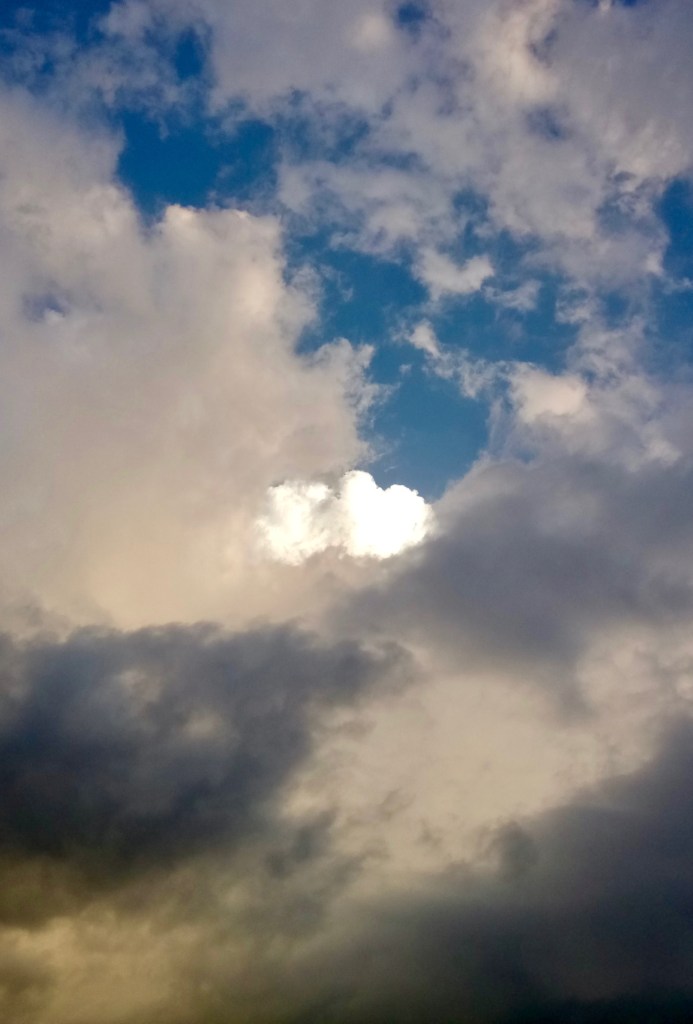
    This helped to normalise for me the co-existence of heightened threat response/withdrawal from social connectedness and the feelings of resentment, disappointment, lack of optimism and sentimentality about places visited pre-pandemic. I even found myself reminiscing wistfully about the lack of aeroplanes in the clear blue sky during the first lockdown, because at least then I wasn’t grappling with anger and envy about all the people travelling (for trivial reasons; I imagined), whilst dreading a situation where I wouldn’t get to see my father before he dies. Now the aeroplanes are back and the sky is cloudy again.
    26th Julyfamily lockdown

    Garden obstacle course


    August – went to Iceland to see half of my family for first time in nearly 2 years; it seemed roughly halfway between the UK and the US, albeit slightly north. Travelling towards the arctic, to a sparsely populated country, felt – in a weird way, to some extent – like leaving Covid behind for a while. I struggle to describe the head-spinning extreme contrast between relief and intense sadness that I felt on this trip; which kicked in only once all our documentation had been approved and we were officially out of the airport and in a new country. I will write a lot more about this trip at some point, but I’m not ready yet.

    Writer’s block…

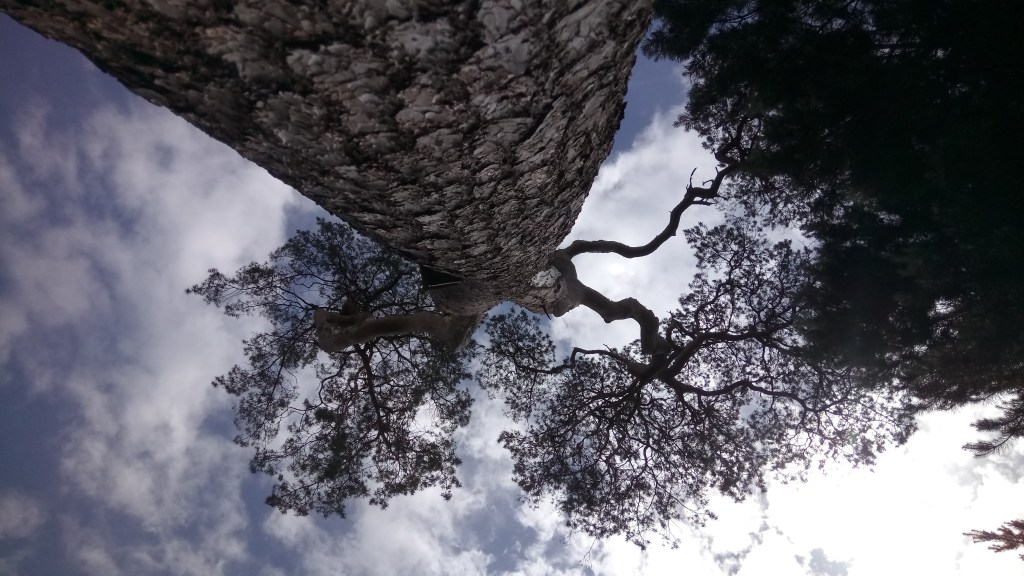
    13th Octmaybe ‘Mild Mild West’ post can be mostly photos: Colorado, Wales & Iceland. With an acknowledgement of writer’s block . About Disappointment, Obstacles & Permission. The leaning tree – support might be not as hard to get to as I thought, it’s the asking for help bit that’s really hard!

    25th OctAn easier day – some space – Brandon Hill – this is what I’ve needed (no far flung adventures, just a nice, safe park close to people). A nice park with water and a view, nothing to do for half an hour or so, not rushing, not stressed, not working, not doing anything for anyone else (for half an hour) – just for me

    ?DateFOG – fear, obligation & guilt – gets in the way of connecting with people – an obstacle – also gets in the way of moving on, letting go – once the FOG has gone, is there anything left of the relationship?

    It’s been nearly 2 years since the start of the first lockdown in the UK. As time went on and I had not produced another blog post, I was on the verge of giving up, so I set a goal for myself – to publish another post by the 2 year anniversary of the first lockdown starting. I’m about a month ahead of schedule, hurray!

    Now, as I reflect on snippets of my experience of the pandemic so far, through finally finding the capacity to engage with this blog process again, I feel profoundly moved by the multiple moments of connection I did have and a bursting gratitude for ‘normal’ daily life. This, existing alongside the disappointment of cancelled plans. One big plan was to go back to The Wild West with my father and family one last time, as a ‘last hurrah’ while his cancer remained dormant. Instead, we had a very different experience – Iceland – where I found my grief on a solid rock beside a huge still lake, somewhere in the Golden Circle.

    And as I think back to those early disorientating days of the virus; the desperate attempts at home-schooling, the interrupted naps (older child waking baby), the blur of sleep deprivation and resentment that my husband didn’t have a job where he could work from home. Groundhog day! Oh, and the visceral envy of my child-free neighbours drinking beer in the sun on a hammock in their garden in the middle of the day!!! Thank goodness for the ‘Lockdown Parenting Hell’ podcast (Rob Beckett & Josh Widdicombe), which I’m re-visiting and chuckling at as I write this – if only I’d found it sooner.

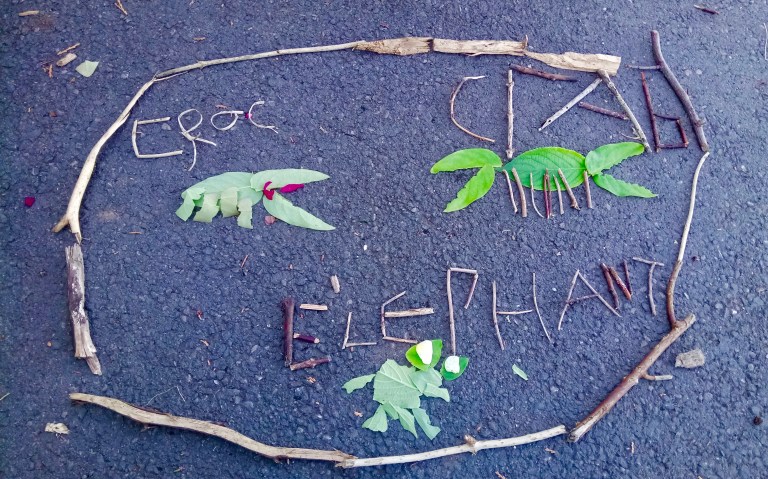
    When I let go of all of that, I remember some really special moments of not worrying or resenting so much, just doing my best, settling for some creative, outdoor home-schooling instead (whilst walking the dog and getting the baby to sleep in the buggy) and this makes me smile.
    © 2022 Psychodography Blog

    REFERENCES

    1. Brous, K. (2014) Stephen Porges: Social Engagement Heals. “Don’t Try This Alone”: The Silent Epidemic of Attachment Disorder. Retrieved from https://attachmentdisorderhealing.com/porges-polyvagal3/
    2. Porges, S. W. (2020) The Covid-19 Pandemic is a Paradoxical Challenge to Our Nervous System: A Polyvagal Perspective. Clin Neuropsychiatry, 17(2): 135–138.
  • 6 Parks in 60 minutes

    6 Parks in 60 minutes

    This morning I leant on a tree, closed my eyes and listened to woodpeckers.

    Schools are back, the birds are busy and there’s a frenzy of activity accompanying spring. How to keep a steady rhythm? Nomar is doing what he usually does, sniffing around looking for tennis balls. Nothing really changes for him, he’s oblivious! Which is quite nice in a way. It has felt essential to keep plodding on throughout the winter lockdown, head down, doggedly looking after kids, working, doing the chores… with very little light relief or anything concrete to look forward to. A hamster on a wheel, whilst juggling. Now that spring has arrived and restrictions are easing (we hope), there may be a tendency to get carried away and overdo it. Make up for ‘lost’ time. I can’t speak for anyone else of course but I wonder if we are a bit institutionalised in our own homes now. A slight panic creeps into my thoughts and muscles when I start to make plans and imagine meeting up with people again, go on journeys, stay overnight at other places. How do we make up for lost time without becoming overwhelmed? It feels necessary to take it steady, a gradual process of creeping out into the world again, blinking and rubbing our eyes.

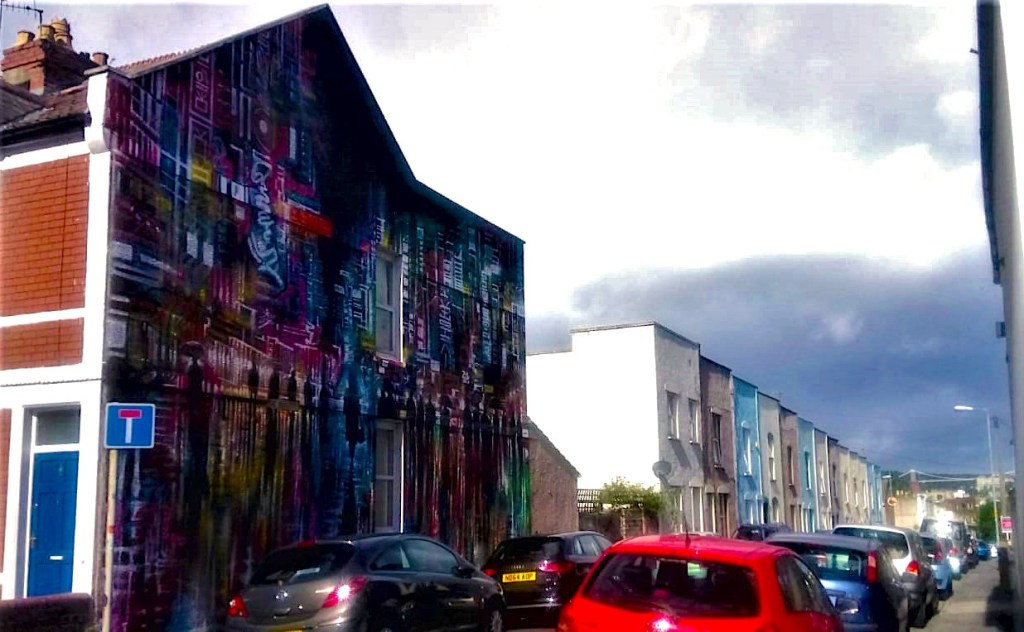
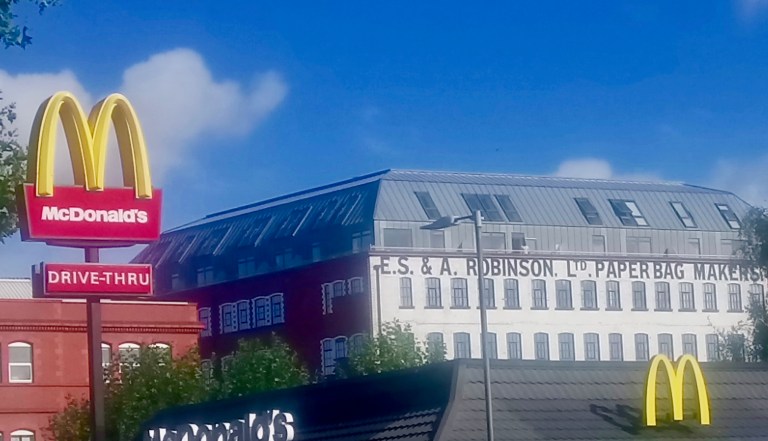
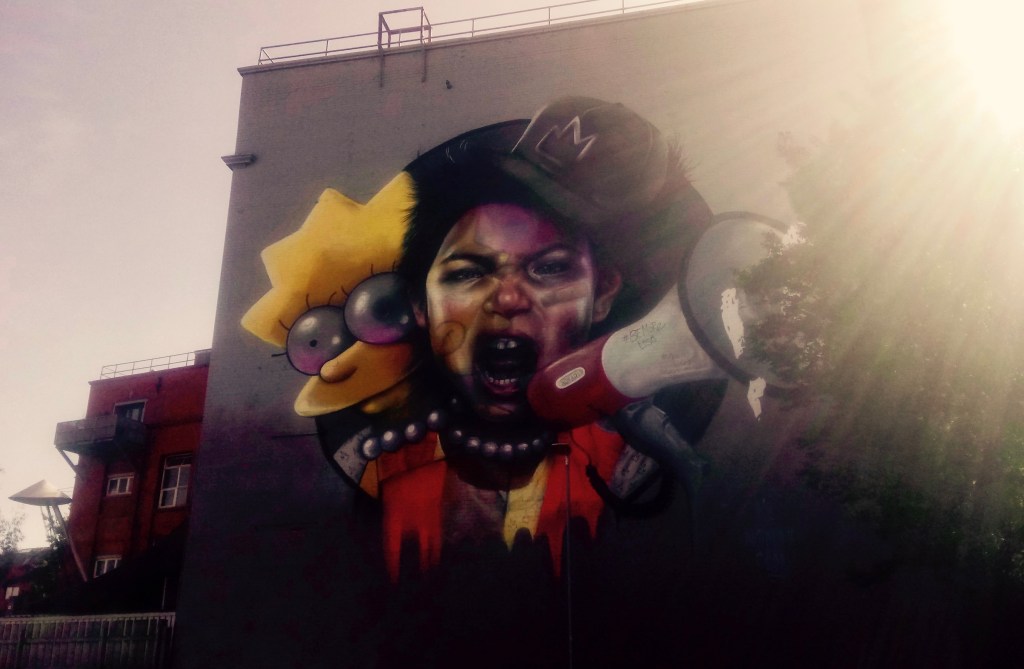
    In September 2018 I found myself free on Fridays to do whatever I wanted. I’d spent many hours in therapy working out how to find more space in my life. Suddenly, I had Fridays. I called it my ‘New Found Friday Freedom’. I decided to set myself and Nomar walking challenges, the first of which was ‘6 parks in 60 minutes’; an epic whistle stop tour of some of South Bristol’s parks and, as it turned out, street art.

    I increasingly felt, as the walk progressed, that I was two people with conflicting agendas – one of me was on the clock, determined to achieve my goal, whilst the other of me was repeatedly distracted along the way by the array of artwork in the streets and stubbornly kept stopping to stare and be mesmerised (much to the frustration of the other part of me and also Nomar, although he frequently stops to sniff anything and everything, which is equally frustrating).

    I took photos from various angles, trying to capture iconic Bristol landmarks in the background.

    Pondering on this push-pull with myself, I’ve started thinking about self-sabotage… putting obstacles in my own way when I set out to achieve something, hence not often deciding to set goals at all or make new years’ resolutions, or only half-arsed ones.  I also struggle on a daily basis to finish tasks that I have started and therefore, I am systematically denying myself that satisfied finished feeling and the rush of dopamine which can accompany it.  I can’t remember now if I was like this before having children, or if it’s a habit I’ve got stuck with, due to getting so used to being constantly interrupted.  I’ve noticed that when I do finish something big which has felt important to me, like a Counselling Diploma for example, I end up with a rather empty feeling inside and find that my mood drops for sometime afterwards.  It is not a surprise that I might struggle with endings and I often associate this with the wrench of leaving the family farm at the very start of adolescence and events which preceded and followed it (mentioned several times in the other blog posts).  

    For this post though, I’m interested in the relationship between the neurotransmitter dopamine and processing of reward.  Whenever we recognise a task as completed, usually – our brains release a load of dopamine and a sense of accomplishment.  Drugs which manipulate the dopamine system are dangerously addictive, as is gambling, for similar reasons.  Sue Gerhardt considers the impact of different types of childhood experiences on the brain and explains,

       ‘With plenty of dopamine activity, the child approaches experience in a positive way.  Dopamine flowing through the orbitofrontal cortex helps it to do its job of evaluating events and adapting to them quickly.  It also helps the child to delay gratification and stop and think about choices of action.  The child with fewer dopamine cells will be less aware of the positive rewards on offer, less able to adapt and think, may be physically slower, and may be more prone to depression and giving up.’

    (1)

    I’m not sure which applies to me… I tend to dwell incessantly on the potential consequences of my choices and actions, to the point where I feel like not bothering at all.  Am I blocking the rush of dopamine, or do I not feel like bothering because I sense there won’t be much of a rush at the end anyway?  Judy Ho (2) seeks to understand self-sabotage and why we get in our own way.  She suggests that it is in built into our survival and associated with attaining rewards and avoiding threats;

     ‘They aren’t independent systems, and there is a constant interplay in the brain to try to bring the two drives to an equilibrium’.  

    Self-sabotage occurs, she says, when our drive to avoid threats is more active than our motivation to attain rewards.  This is the tendency to over-estimate threats.  Thinking about striving for an equilibrium, got me reading more about polyvagal theory (3).  Before polyvagal theory, our nervous system was pictured as a two-part antagonistic system involving the sympathetic (fight/flight) and the parasympathetic (freeze/flop/fawn) nervous systems.  Polyvagal theory proposes the existence of a more cooperative, coherent ‘Social Engagement System’ (4); more of a parasympathetic-sympathetic interplay, 

       ‘The Polyvagal Theory provided us with a more sophisticated understanding of the biology of safety and danger, one based on the subtle interplay between the visceral experiences of our own bodies and the voices and faces of the people around us. It explains why a kind face or a soothing tone of voice can dramatically alter the way we feel. It clarifies why knowing that we are seen and heard by the important people in our lives can make us feel calm and safe, and why being ignored or dismissed can precipitate rage reactions or mental collapse. It helped us understand why attuning with another person can shift us out of disorganized and fearful states. In short, Porges’s theory makes us look beyond the effects of fight or flight and put social relationships front and centre in our understanding of trauma. It also suggested new approaches to healing that focus on strengthening the body’s system for regulating arousal.’

    (5)

    Therefore, our experiences of relationships and most notably, relationships in our childhoods, seem crucial for understanding the choices we make throughout our lives and our approaches to achieving our goals or avoiding them.  The impact of the pandemic and lack of social contact feels very relevant here too; in understanding why the world may feel a more threatening place now, even as the virus recedes, and why this may be exacerbated even more for some depending on their history. Meeting friends in the pub is not necessarily the relaxing and liberating experience it may once have been.

    Generally though, I often assume I am dealing with opposing forces within myself; a contrast between new choices and old habits, the paradox between wanting to challenge and make an impact or retreating into the shadows, the mismatched forces of anger and fear.  Family roles surely come into this.  For example, the Simpsons has been cited as demonstrating well-known family roles (6) such as ‘Hero’, ‘Scapegoat’, ‘Lost child’.  Lisa, for instance, is equated to the ‘Family Hero’; driven and striving for perfection, avoiding failure and shame at all costs, being the ‘good girl’ (with rage and resentment lurking in the background because it is a very difficult burden to shoulder).  I used to consider myself very ‘driven’.  I later realised it wasn’t sustainable and was detrimental to my health.  

    This began, I think, when I was going through the Clinical Psychology application process for the 4th time and had been offered 4 interviews. During the second one I froze and then burst into tears. I quickly went into flight mode and left there and then, promptly returning to the train station to go straight home, a journey of several hours. I sobbed the whole way. I cancelled the other two interviews and decided to never apply for a Clinical Psychology Doctorate ever again. This was a minor breakdown and major breakthrough. I find it fascinating now to seek to understand when self-sabotage is actually self-protection, self-preservation – when it is more of a help than a hindrance, to put it mildly. It had been drummed into me as a child that I wasn’t a ‘quitter’. So quitting this particular goal has become one of the most alleviating and liberating things I have ever done. I gave up. Ever since, a line from one of my favourite films, Garden State (7), often pops up into my mind: “I’m okay with being unimpressive, I sleep better”. I became happy to settle… and I mean settle in all senses of the word, including neurophysiologically… I became happy to settle for a 6 mile walk, with regular breaks to take photos and the reward of a delicious Chai Latte and cinnamon bun cake.

    This was the first and finest Chai Latte I had ever tasted, the sensory experience on my taste buds and olfactory system was intense.  I soon discovered this was partly because I was pregnant with my second child – the biggest obstacle possible to my New Found Friday Freedom! The next week I was tired and decided to stick to 3 parks in 30 minutes.

    © 2021 Psychodography Blog

    REFERENCES

    1. Gerhardt, S. (2004, 2015) Why Love Matters: How affection shapes a baby’s brain.  London/New York: Routledge.
    2. Ho, J. (2019). Stop Self-Sabotage: Six Steps to Unlock Your True Motivation, Harness Your Willpower, and Get Out of Your Own Way. HarperCollins: New York, NY.
    3. Porges, S.W. (2011) The Polyvagal Theory: Neurophysiological Foundations of Emotions, Attachment, Communication, and Self-regulation.  W. W. Norton & Company. ISBN 978-0-3937-0700-7.
    4. Porges, S.W. (2015) Making the World Safe for our Children: Down-regulating Defence and Up-regulating Social Engagement to ‘Optimise’ the Human Experience. Cambridge University Press.
    5. Van Der Kolk, Bessel (2014) The body keeps the score: brain, mind, and body in the healing of trauma. New York: Viking Penguin. p. 80ISBN 9780670785933. Retrieved 3 February 2018.
    6. Sweet, M. (2014) Dysfunctional Family Roles (Illustrated!). Retrieved from: blog.mattsweet.com
    7. Braff, Z. (2004). Garden State. Fox Searchlight Pictures.
  • Stepping out…

    Stepping out…

    Please proceed with caution if you come across this and have had some similar experiences to those described below – I was triggered for a long time by some of the same and similar words to those used in this post, which was why I didn’t include those words in much of my writing, until recently. This is where I make clear and plain some of the story that was missing (but alluded to) before. If this causes anyone pain or distress, I am very sorry. Please get in touch if you need to.

    This process started over 5 years ago. Why then, did I choose to make it public at the end of 2020? Because Layla F Saad said,

    ‘Introversion is not an excuse to stay in white silence… You can be an introvert and have powerful conversations. You can be an introvert and use writing to disrupt white supremacy. You can be an introvert and show up to protest marches. You do not have to be the loudest voice. But you do need to use your voice.’ (1)

    Since starting this process in 2016 for my research dissertation for a Counselling Diploma, it has never felt finished.  Those were simpler times, although I did not know that then and by no means did life feel simple.  Perhaps these are simpler times; a global virus spreading like wild fire, while wild fire destroys much of Australia.  Perhaps this is all to be expected given the climate emergency.  Perhaps, perhaps, perhaps… (it has just occurred to me how often I use this word and I have searched back through the original document and tried to find alternatives to my ambivalent perhapses).  

    I have dipped in and out of this ‘project’ over the years and finally came back to it in 2020 with the intention of finishing it and figuring out what, if anything, to do with it.  During the past 4 years I have had EMDR (Eye Movement Desensitization and Reprocessing) therapy, I have reported the rape that happened to me at age 15, a close friend tragically died from bowel cancer, I had my second child, a son, who was born on exactly the 1st anniversary of our friend’s death.  Meanwhile, global tensions rise, racial inequality intensifies and we enter the age of coronavirus. I recently returned to the article Walking Together (2), one of the main early influences for ‘Psychodography’. I was particularly drawn to this;

    ‘It seems to me that therapy cannot afford to ignore social justice. Psychogeography offers a radical, subversive, challenging critique of space that psychotherapy can benefit from…As Psychotherapists and counsellors we are engaged in the vital challenge to understand and communicate at depth with different cultures, races, and experiences…In our thinking too, we need to cross boundaries.’

    I doubt there’s anything radical or subversive about my walking, thinking or writing… it’s early days still. Then again, self-doubt is something I continually battle with.

    Within the constraints of our current circumstances i.e. global pandemic, what I’m trying to focus on the most is my intention, whilst identifying what there is yet to attend to in my own personal processing which may be holding me back, still. In terms of trauma recovery, I know I’m on the other side of the tunnel… I know this because there’s a circle sculpture in Arnos Vale Cemetery and I used to stand at a distance from it and stare at it, not through it, and sort of zone out at the same time. Now though, I approach it from the other side, with purpose and clarity. I wrote this sometime in the summer,

    ‘The circle. I can walk straight up to it from behind, bold as brass, and look straight through to the other side – I know what this means but I don’t suppose others will…’

    I also know it because I no longer get flashbacks or unpleasant triggers from listening to certain types of news. I can talk about what happened without dissociating or retreating into shame. I guess this part is probably easier for people to get their heads around than the circle/tunnel thing. At the start of EMDR, the therapist said something like, ‘do you want to focus on the first, the worst or the most recent?’ (traumatic memory). The worst is now no longer so active in my mind, it’s further away, faded, as any memory should be. Nevertheless, I think I have to keep working on it (the recovery I mean), like a muscle, and never get complacent. I feel the need to put it somewhere to keep an eye on it, hence part of the reason why I have put it here.

    It feels significant that I am finishing off this post in February too (only just), as it was in February that the rape happened, 23 years ago. I’ve often struggled with February and didn’t understand why for a long time. I mean, it’s not an easy month anyway, even without a lockdown (or a rape; tragically for many people, they have to endure both) – not quite spring, not quite light enough, not quite warm enough. The weather still feels harsh at times, resources are low from nearly 3 months of winter. This February, I’ve tried to notice warmth and softness wherever I can. The captivating gentle flurries and soft dusting of snow – if I stare at the snow falling for long enough, it takes on a sort of magical, unreal quality. Occasionally (childcare allowing), I have a warm bath when I get home, then wrap myself up in a blanket. And every evening I still light a candle of course. Perhaps each candle is for each person being abused around the world, I’m going to need a lot of candles! What does it mean when I blow the candle out?

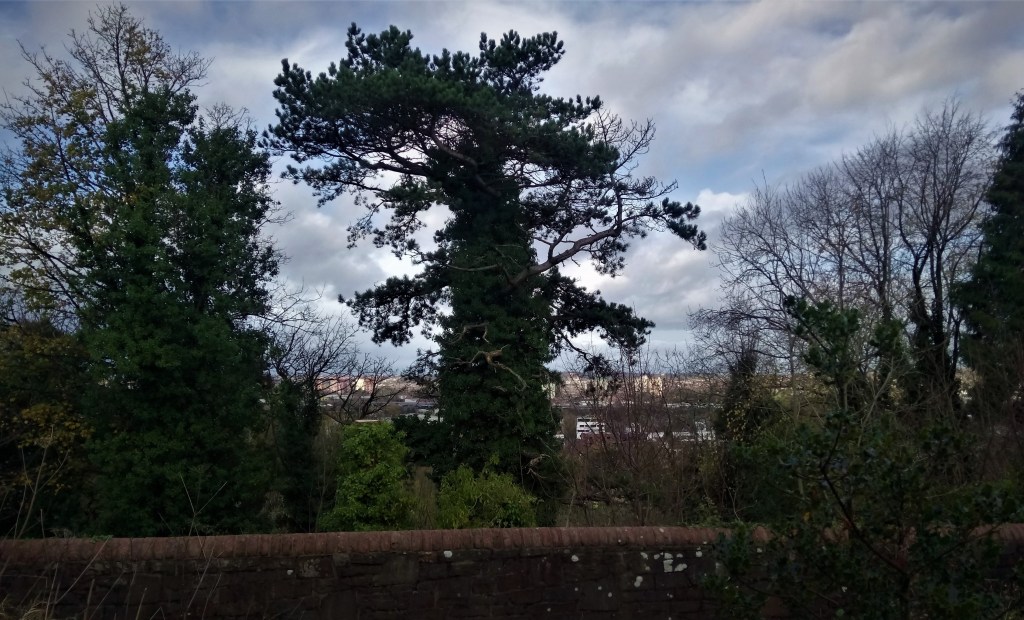
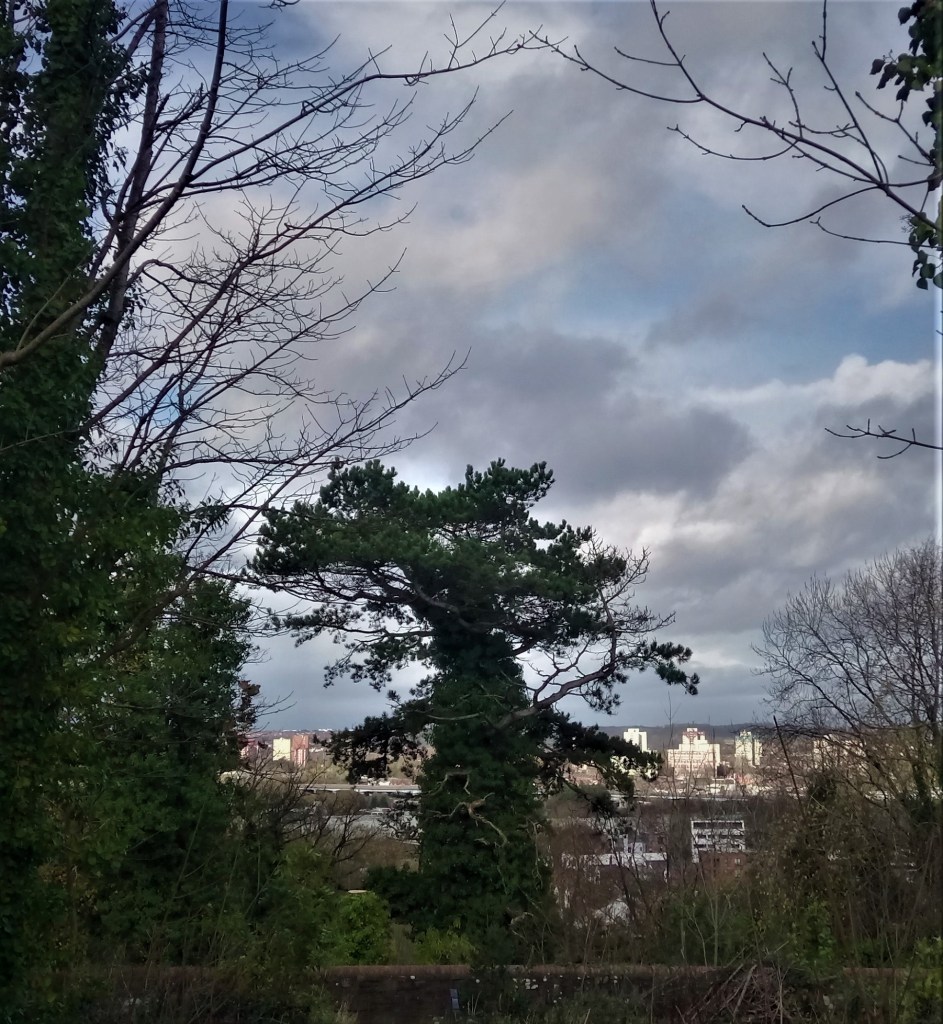
    I took a photo of what I now like to call the woolly tree; it’s a very tall tree engulfed in ivy, it looks like it has a massive body warmer on! I found myself gazing beyond the woolly tree, into the distance, at the tower blocks. I wondered what it might be like in lockdown to not have a garden or even a safe green space close by.


    To say a bit about the EMDR and the rape – I did not want to include this within the main story because the story is not about the rape, it is about self-care, about the anti-dotes to rape trauma (for me). Yet, it feels important to share something about EMDR, in case it’s helpful to others who might benefit from it, and it doesn’t make sense to mention EMDR without mentioning what I was having it for. EMDR was discovered by Francine Shapiro (3) while she was walking in the park (I like to think she had a dog with her too); this was one of the reasons it appealed to me. The aim was to push the trauma ‘through the tunnel’ and come out the other side with the memory processed, as all memories should be, and no longer lurking in the amygdala; ready to pounce at any given moment at the slightest perceived threat, the slightest mention of a similar experience on the news or by a colleague or client, the slightest re-visiting of the trauma with a therapist or in a personal development/therapy group. 

    Thankfully, the memory was indeed processed and began to fade.  It was no longer right up in my face when I closed my eyes in the shower, there was no longer a contaminated feeling within me.  I will admit, and a gentle warning to others thinking of trying it, it was unpleasant.  The kinds of things that my consciousness needed to do to the perpetrator in order to break the fixed images and hypo-arousal; experiment with alternative realities that at the time were not possible… these things were unpleasant, violent, powerful, disturbing and …necessary, to free that ‘freeze’ and ‘flop’ response (please see ‘Magic Pool’).  Doing this ‘work’ with a recommended and very experienced therapist, and having done the many years of ‘groundwork’ that preceded it (including this project), I was finally able to talk about the event with the police without becoming de-stabilised. Finally able to find some kind of closure. 

    Choosing to embark on a counselling diploma (and further unearthing lurking traumas) whilst looking after a very young child, may have been foolish.  I had to be very careful and patient around how and when I was going to process such experiences and be able to continue functioning as a parent day after day.  Maybe it took longer than it otherwise would have, but in that process I have learnt invaluable grounding tools that will stay with me for the rest of my life.  The worst trauma had already been unearthed, I suspect mostly by childbirth (I’ve since heard that this can be quite common – one of the many unfair paradoxes of life; a beautiful bright baby is born and at the very same time, our most hidden darkness emerges from the depths). 

    It wasn’t a sudden thing, it was a gradual process, amplified I’m sure by sleep deprivation and lack of space/time for myself (‘a perfect storm’ e.g. Mothers on the Edge; 4). Thankfully, it wasn’t quite ‘a perfect storm’ for me, but it was stormy. Flashbacks from the trauma were becoming increasingly intrusive and frequent.  So what better time, i supposed, to try to resolve it than during a supportive and safe counselling training course and ongoing therapy, a time when my support network was bigger and safer than it ever had been. I was being held by a huge container (e.g Bion, 5) of compassionate people.  

    The choice to report it was in the hope of reaching some kind of closure and because finally, 20 years after the event, I was able to cope with doing such a thing.  I did not feel I could live the rest of my life with the knowledge that I had never reported a very serious and by its nature, very violent, crime that was inflicted upon me as a teenage child.  I did it for the childhood that abruptly came to an end and for the woman I have struggled to become.  I did it for my daughter and the woman she will become (and now, for my son and the man he will become).  I also did it in case there was even the slimmest of chances that it might link to other, similar crimes, committed by the perpetrator.  Of course this did not happen (as far as I’m aware) and even to this day a residue of guilt and shame remains that I did not go to the police at the time or even tell my parents what had happened.  And then I remind myself… it was a different time, a different culture, it happened in a different country where I did not speak the language and where the age of consent was 14 and I may not have been believed that I had said ‘NO’. 

    Nevertheless, I did not even understand I was child at the time, and I was still reeling with hurt and anger about my father leaving our family the year before.  The holiday was supposed to help us re-connect.  Instead, I was bought alcoholic drinks in a bar, I was raped by a man more than twice my age, my father was searching for me all night and the next day he had an accident (which I witnessed), leaving him with a fractured spine and wearing a body cast for 6 months. The complex interweaving of these two traumas happening so close together and both feeling, for a long time, like my fault – caused my need for help and recovery to plunge down into the depths and not resurface for over 10 years; during which time I struggled with relationship problems, alcohol dependence, depression and anxiety, PTSD symptoms, irritable bowel syndrome, psoriasis and chronic urinary tract infections. I don’t know if all or any of these ‘symptoms’ were linked to the rape trauma, and/or other events and experiences in my life. What I do know is that now, ALL of them have improved.  

    Now that I’ve got here, I’m not sure what to do with my recovery next. Perhaps this relates to Babette Rothschild’s ‘KEY 8: Make Lemonade’ (6). I hope I have done a bit of this already in my counselling work. I want to do more. Michaela Coel’s bold and eloquent words in ‘I May Destroy You’ may help demonstrate what I mean (below). I had already decided to refer to this mighty quote and now it feels all the more important, after the show was unfathomably snubbed by the Golden Globes,

    “Do I actually know what it is to be a woman struggling?  A little rape in the mouth is a walk in the park when other girls are currently being stoned to death for having mobile phones, are bleeding to death after genital mutilation, are looking at a womb irreparably destroyed by militiers systematically raping them during times of civil conflict and war.  Are these facts a humbling reminder not to be so loud about my experiences, or are they a reminder to shout, can my shout help their silent screams?”  

    (7)

    Maybe it goes without saying, it wasn’t exclusively a rape in the mouth (I don’t think it was for Michaela’s character either, but I see her reasons for putting it this way). Nor, however, was it any of the other atrocities included above. Yet, answerless questions have often echoed around my head… How bad was my trauma?  How bad was my trauma in the context of being white, middle-class, privileged?  Perhaps the guilt and shame and silence and passivity and ambivalence… I was paralysed by for such a long time, go much much deeper than I first thought. 

    ‘Imagine a world where what women need rolls off the tongue with ease, and we no longer remember that there was a time when this conversation didn’t exist’

    (8)

    The conversation still does not exist for many women. I intend to move past my personal experiences, continue to crack open my toxic ‘learned silence’ (9) and find a voice to express the wider injustices, cruelties and catastrophes, which unquestionably deserve a torrent of shouts.

    It is time to ‘show up’ (1) for others and not just primarily other white women – as I did at a Women’s march after Trump’s inauguration, but failed to show up for the BLM march in my home city last year. There were many excuses not to go – the virus, the baby… and in hindsight I wonder if I thought it wasn’t my struggle. No it’s not my struggle, but it is my responsibility, I see that now. I get it. Or at least I’m closer to getting it than I was a few years ago. I also get it that this learning will be a lifelong challenge.

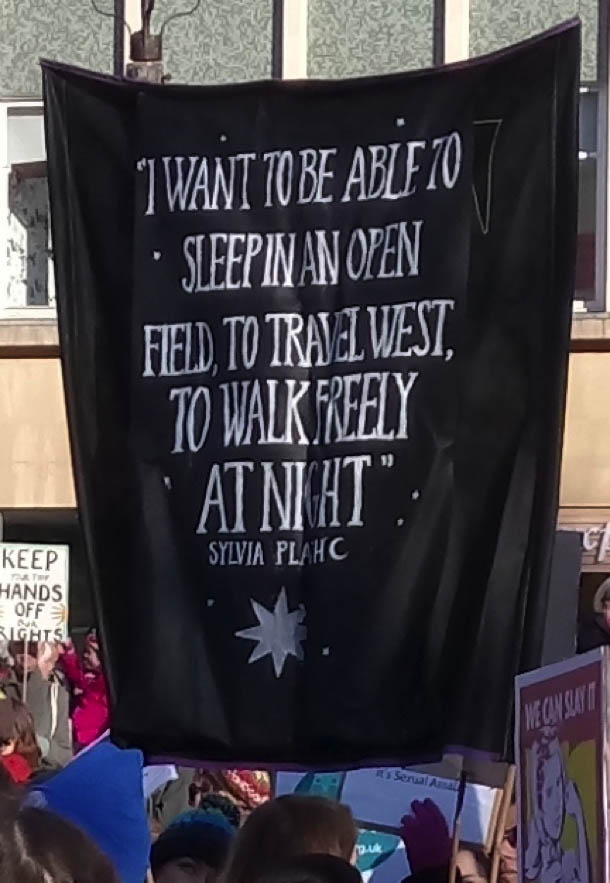
    This (above; 10) is what I was more focused on at the time of the Women’s march – what I wanted… to feel free from trauma and threat. To feel unconstrained by it. This seems irrelevant now in our new lockdown lives and it’s all relative anyway right? Maybe this desire will return one day and maybe (I seem to have swapped ‘perhaps’ for ‘maybe’) I’ll go and fly that kite on Chesil Beach, as was my intention after my weekend trip to the Dorset Coast with my dog (please see ‘The Experiment’). I do have the freedom to make that choice. In the meantime, other priorities feel more pressing.

    This is my first ‘step out’ of my comfort zone with regards to confronting my white privilege and starting to try to articulate my understanding, with the help of the wise and bold words of women (and men) whom I admire; that I cannot compare my struggles with all women, that it is my white responsibility to sort my own shit out and reach out to others… ALL others. I have so much more to learn about how to turn my silent rage into more ‘eloquent rage’, such as;

    “Real radicalism implores us to tell the whole ugly truth, even when it is inconvenient. To own the hurt and the pain. To own our shit, too. To think about it systemically and collectively, but never to diminish the import of the trauma.”

    (11)

    It took me over half of my life to even begin to take this risk. I don’t want to waste any more time, yet frustratingly… forbearingly… I know I need to tread carefully. I intend to one day (soon, hopefully) add a photo to this blog from a BLM or other anti-racism march, at the very least. My intention for 2021 though is to keep walking, keep writing and keep learning.

    © 2021 Psychodography Blog

    REFERENCES

    1. Saad, L. (2020) Me and White Supremacy: How to Recognise Your Privilege, Combat Racism and Change the World. Sourcebooks.
    2. Rose, C. (2016) Walking Together, Therapy Today, 22-25.
    3. Shapiro, F. (1989). Efficacy of the eye movement desensitization procedure in the treatment of traumatic memories. Journal of Traumatic Stress Studies, 2, 199–223.
    4. Theroux, L. & Casebow, M. (Director) (2019) Mothers on the Edge. BBC Two.
    5. Bion, W. (1962). Learning From Experience. London: Karnac Books.
    6. Rothschild, B. (2010) 8 Keys to Safe Trauma Recovery: Take-charge Strategies to Empower Your Healing. W.W. Norton.  New York.  London.
    7. I May Destroy You (2020), directed by Sam Miller, Michaela Coel. BBC One, HBO.
    8. Hasseldine, R. (2017) The Mother-Daughter Puzzle: A New Generational Understanding of the Mother-Daughter Relationship . Women’s Bookshelf Publishing.
    9. Hasseldine, R. (2007) The Silent Female Scream. Women’s Bookshelf Publishing.
    10. Plath, S. (2000) The Unabridged Journals of Sylvia Plath, edited by Karen V. Kukil. Anchor.
    11. Cooper, B. (2019) Eloquent Rage: A Black Feminist Discovers Her Superpower. St Martin’s Press.
  • Magic Pool

    Magic Pool

    On our walks, Nomar and I ‘move apart and we come together, with synergy, unspoken (mostly), without effort, like a dance’.  I feel a profound sense of belonging, I wonder if he does too?  Merleau-Ponty, a French phenomenological philosopher, suggested perception plays a foundational role in understanding the world as well as engaging with the world. His outlook was naturalistic in that ‘it sees human beings as integrated into the natural order, as fundamentally belonging to the world…’ (1)

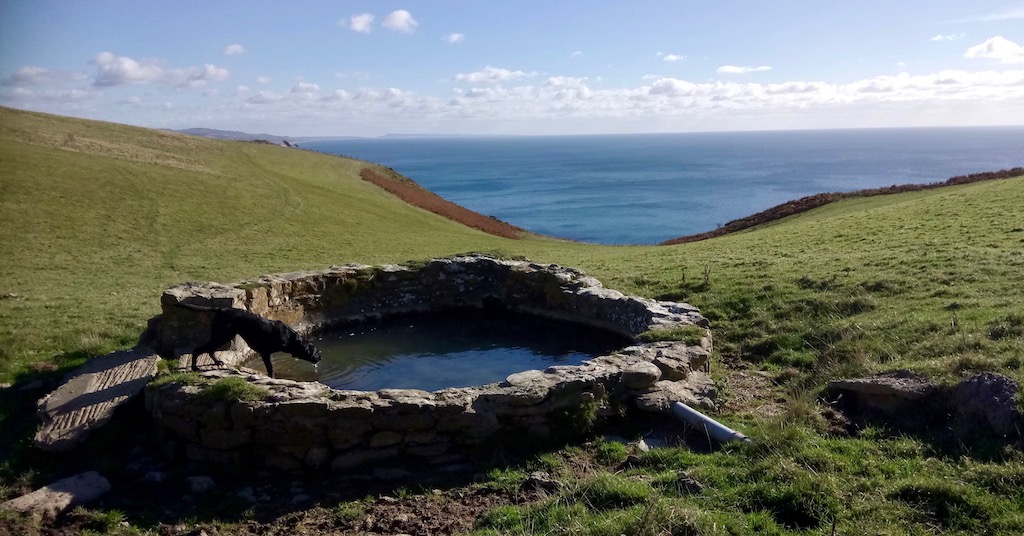
    I thought Ashton Court would be my final destination in this story.  I found the voice recordings, the walking notes, etc., were detracting from my here-and-now experience, so I decided that was the end.  A month later I started again, there was more to say, more to record and listen back to, more to write, more to capture of the experience and cherish and use as powerful reminders of the restorative quality of these walks with my dog.  I realised I could do both; a little bit of recording and capturing, but mostly just practising staying present in each moment (2).  I grew in confidence, more at peace with myself and my choices, more authentic?  Walking further than before I came across a round pool, similar to the ‘magic pool’ I found on the Dorset cliffs into which I could imagine my past, present and future, reflected back at me – so clichéd I know, but that’s what I felt all the same.  Radiohead’s album ‘A Moon Shaped Pool’ (3) and the song ‘Present Tense’ kept going round and round in my head at the time.  

    I continue to explore power and vulnerability in the rich, green, open areas within the city and how this feels in my body, in relation to my surroundings.  Coming back to Merleau-Ponty, he emphasised the body as the primary site of knowing the world. I think I know what he meant. The power of movement is an essential antidote to persistent ‘freeze’ response (4) in my trauma recovery and building up muscle strength, which I feel is also an antidote to ‘flop’; one of the less well documented threat responses (5,6,7). 

    With this sense of power and my anchor [my dog] by my side, I can more deeply tolerate my vulnerability in the world.  Just up from the pool, there is a small patch of woodland with a triangle of branches on the ground.  I walked along them balancing in a childlike, playful way, and then stood, bold, arms in the air, eyes closed, feeling the power and vulnerability in my body simultaneously.  I could hear and feel Nomar close to me, just lying and waiting on the ground and I could keep my eyes closed for as long as I felt like it, no need to check over my shoulder in case of a threat.  Safe and secure and free.  I imagined being connected to the roots of the dark green trees with silvery-blue threads.  Right now as I write this, I have two songs by Timber Timbre playing in my head; ‘Woman’ and ‘Do I have Power?’   

    Trauma is explained by Kohut (8) as an affect overwhelming the mind’s capacity to maintain its balance.  If the seeds of vulnerability are sown early on, due to mis-attunement and lack of empathy, narcissistic injury is likely; a difficulty restoring balance when self-esteem is upset.  Consequently, rage is perhaps a breakdown of a child’s ‘innate healthy assertiveness’.  It is suggested a child can form a compensatory attachment with an object (or an animal?) and I feel that my assertiveness became embedded in my relationships with animals.  As a woman out with my dog I seem able to re-connect with stagnant rage and experiment with moving it through my body and voice, in a way that feels safe for me. 

    There is something about permission which has been creeping into my thoughts, recordings and notes. I have felt resistant to exploring this.  It seems dogs give me permission to seek my own space, guilt free.  Playfulness is considered an antidote to guilt, linking to Erikson’s Initiative vs. Guilt stage of development (9).  Having finished the counselling diploma several years ago and submitted a shorter version of this story within the constraints of the word limit, I have now taken the initiative to come back to it and give myself permission to continue with the process, just for me.  Nomar and I continue with our cemetery, park and river walks, we return to Ashton Court from time to time and I am planning a return to the Jurassic Coast, hopefully with the whole family – obviously as restrictions ease.  I notice that I do not feel quite so angry or quite so sad or quite so fearful. 

    One June I was struck by a sense of softness and stillness. I found myself reflecting on the Woodland Wellbeing group for people affected by Dementia. I was co-facilitating this group at the time along with two incredibly knowledgeable and creative ‘forest ladies’, as I like to call them! I wrote this as I recalled the latest session,

    ‘yesterday the fairy fluff offered to us from the willow trees softly caressed our faces and hair as if inviting us to stay still and be nourished, attending to each person equally, there is no judgement from the trees.  Willow is welcoming to all.’  

    In the summer months, in Ashton Court and Victoria Park, I often notice the abundance and variation of meadow flowers, the colours, the grasses and birdsong.  I delight in watching (Nomar) as he,

    ‘glides through a shimmering mist in the tall grasses… covered in shiny dew droplets and grass mist and tiny bright green seeds… he has become a pollenator’   

    Kohut’s endorsement of ‘playful creativeness’ (10) and my focus on experience of the environment seems to mirror my newly evolving psychogeography practice, with its emphasis on playfulness and “drifting” around urban (or sometimes rural) environments.  Hart described psychogeography as a ‘slightly stuffy term’ for, 

    “A whole toy box full of playful, inventive strategies for exploring… just about anything that takes pedestrians off their predictable paths and jolts them into a new awareness of the… landscape.”  

    (11)

    I am on an experimental pursuit of balance between past and present, light and dark, and that of multiple selves encompassing a whole.  Clients and counsellors alike are treading out new and unpredictable paths, etching new landscapes in the mind, abating the habitual and dissociative.  

    There is a simple version and a complex version of this autoethnographic process.  The simple version; I love going for walks and spending time with my dog and this is largely my only respite at this stage in my life.  The complex version I hope I have gone some way to clarifying in the other sections.  For this expedition I have had to engage the trust in my feet, the courage in my belly and the hope in my heart, to go out into the world and put the past behind me.  My mind, my imagination, have also become integral to this process.  Much of this is summed up nicely in my favourite of my children’s story books, ‘Augustus and His Smile’ by Catherine Rayner (12); where a sad tiger roams the world in search of his smile. 

    My counsellor and I have often talked about how wonderfully present children are, as well as dogs.  I love my daughter’s certainty about the things she likes; ‘I’m climbing and I do like it’ with the emphasis on the ‘do’.  Through becoming more present with myself, others and the world, I am moving beyond trauma, beyond grief and beyond ambivalence, towards a more solid sense of identity and belonging. 

    It greatly disturbed me to have my gender equality bubble burst upon becoming a mother/parent. The pervasive stereotypes and expectations based on gender; of both parents and children, has been shocking to me. Surely we’ve moved past this, I thought.

    Simply being in the world with my dog when I’m not fitting into some kind of role, is when I feel truly settled in myself. I am a person, I am a woman and I belong in the world.  I have friends and family; animal and human alike.  I am a wife AND a life partner.  I am a mother AND a co-parent.  I have been scared, lonely, trapped and in pain and right now I am safe, loved and free, and I am grateful.  I am becoming a counsellor, I am a counsellor, and I do like it.

    © 2021 Psychodography Blog

    REFERENCES

    1. Moran, D. (2000) Introduction to Phenomenology.  New York: Routledge.
    2. Stern, D. (2004) The Present Moment in Psychotherapy and Everyday Life. W.W. Norton.  New York.   
    3. Radiohead (2016) A Moon Shaped Pool.  XL.
    4. Rothschild, B. (2010) 8 Keys to Safe Trauma Recovery: Take-charge Strategies to Empower Your Healing. W.W. Norton.  New York.  London.
    5. Ogden, P. & Minton, K. (2000) Sensorimotor psychotherapy: one method for processing traumatic memory.  Traumatology, VI(3), article 3.
    6. Porges, S. (1995) Orienting in a defensive world: mammilian modifications of our evolutionary heritage.  A polyvagal theory.  Psychophysiology, 32, 301-318.
    7. Porges, S. (2004) Neuroception: a subconscious system for detecting threats and safety.  Zero to three, May 2004, 19-24.
    8. Kohut, H. (1972) Thoughts on narcissism and narcissistic rage.  Psychoanal. Study Child 27:360-399.
    9. Erikson, E. (1998). The life cycle completed. New York: Norton.
    10. Siegel, A. (1996) Heinz Kohut and the Psychology of the Self (Makers of Modern Psychotherapy).  New York: Routledge.
    11. Hart, J. (2004) A New Way of Walking.  Retrieved from http://www.utne.com/community/a-new-way-of-walking  
    12. Rayner, C. (2006) Augustus and His Smile. Magi Publications: London.
  • Borrowed Dogs

    Borrowed Dogs

    In August 2016 my father went into cardiac arrest and had no pulse for 7 minutes.  He was in intensive care for nearly a week and miraculously returned home unscathed not long after; roughly the fourth of his apparent nine lives.  This was following several years of cancer treatment – he had been in remission for some time and was beginning to feel better before his heart mysteriously stopped, so is the bitter irony of life.  His first (I think) near death experience – I witnessed within 24 hours of a traumatic ‘event’ when I was 15 years old.  The confused intertwining of this double trauma produced excessive shame and guilt which is too long and painful a story to go into here.  Rothschild’s ‘KEY 5: Reconcile Forgiveness and Shame; Part A. Forgive Your Limitations, Part B. Share Your Shame’ (1) has been invaluable, amongst other ‘shame’ literature, along with counselling placement training and supervision.


    Following what felt an excruciating decision to rush out to the US that August, the mindful tools; walking, noticing the surroundings and my movement, etc., I had picked up thus far, became essential.  My Dad and Step-Mum had two dogs at the time (see above; a Bassett Hound called ‘Violet’ and a Chocolate Labrador called ‘L’il Pork Chop’, or ‘Lily’ for short, who is sadly no longer with us). I borrowed them quite a lot, took them to the sea and the woods, sat outside with them in between visits to the hospital.  In the US suburbs, a person walking is not a very common sight, there are not many pavements, but walking with a dog along the pavement is kind of acceptable.  Devika Chawla’s descriptions of walking in the US and the incongruences with her childhood home come to mind, 

    ‘the absence of human bodies on the road made me almost apologetic for being on foot… the landscape was flat, boring, and dismal, a stark contrast to the lush and familiar greenery of the Himalayas – but putting my feet to the ground somehow made the place less strange making it almost a part of me.’ (2)

    My Dad’s place is sort of a home-from-home, despite being so far away.  Yet being there without my new family was almost unbearable.  The walking kept me stable and their dogs became my compensatory attachments (e.g. Kohut, 1977; 3).  Evening rituals helped me sleep and I practised grounding myself by holding my hand to my heart when it was aching and breathing steadily as the tears were welling up inside.  I now often use my most special stone from the Dorset Coast (please see ‘The Experiment’) in a similar way to ground myself. 

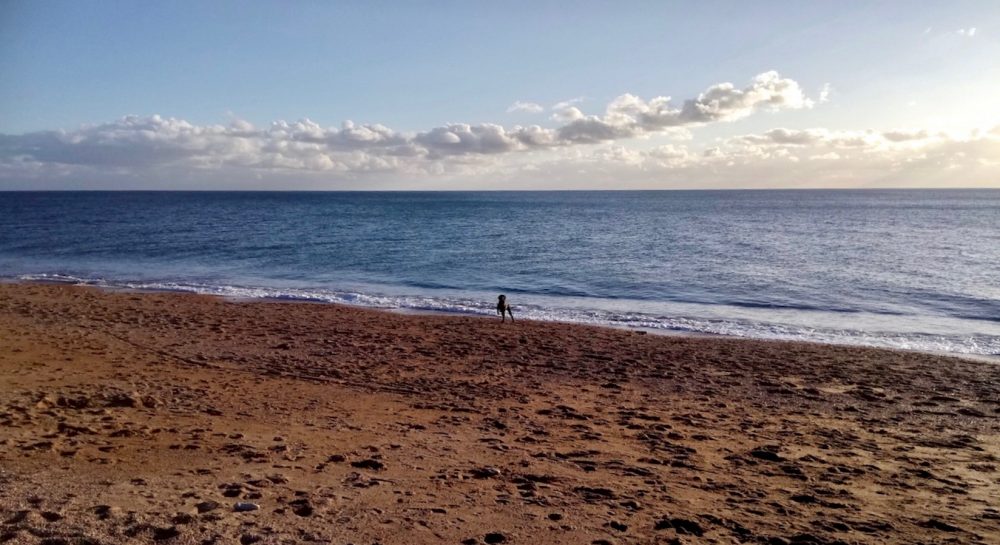
    I went back to my Dad’s with my husband and daughter on our actual pre-planned trip and we all went to stay in Provincetown, a wonderfully liberal peninsula.  The locals describe the sunrise and sunset as ‘the special light’.  In the morning the tide is out so far that it feels like walking for miles out to sea.  This is one of my ‘safe’ spaces in my inner world of memory and imagination, the other being the Dorset Coast with my dog – lying on a pebble beach with my eyes closed, the warm sun on my face, feeling secure against the firm stones, hearing the comforting sound of my dog paddling in the shallows, smelling wood smoke from the café behind us, refreshed by the cool sea breeze stroking my skin – as gentle as a feather, immersed in the senses and elements, content.  

    On the emergency flight over to the US that year, I watched a film about grief called ‘Demolition’.  It would have been a nice change that I was watching a film in peace without my 2 year old, had I not been agonising over whether my father would be alive or dead, or somewhere in between, when I got there.  I later came across a small article about the same film by Julian Edge (a counsellor with Age UK at the time) in the BACP magazine (4).  Edge described the storyline as a little ‘convoluted’, with the main character’s ‘desire to dismantle and destroy things – objects, machines, houses’ as a reaction to his grief. I felt, on the other hand, that this aspect of the story was captivating and empowering, almost addictive as an idea. This led later to some long overdue processing of my inner rage in therapy, which involved visualising myself driving a bulldozer and demolishing several houses I have lived in since leaving my childhood farm… until I got back to the farm in the bulldozer, stepped out, stood there and couldn’t work out what to do next. 

    For a while I was working towards actually, physically, demolishing something, maybe with a hammer, and I briefly (for about 2 minutes) looked into demolition jobs but was put off by the asbestos, amongst other things.  I now also wonder if I was drawn to this idea because counselling training and/or therapy are sort of a process of dismantling oneself and then putting the pieces back together again, maybe discarding a few along the way, or finding new ones… and then, preferably, forming a more cohesive whole – allowing the sharp, fragmented, warped memories to soften and fade. Power and movement, destruction and creation, seem crucial for me in releasing what has long been stored up and turned in on myself.

    Retroflection, from the Gestalt cycle of experience, can be described as the movement of an ocean current that doubles back on itself.  I wonder if this is often where I have got stuck on the cycle.  Creating more movement, with my voice, my body, my senses and in my imagination, serves to shift some of the stuckness.  Merleau-Ponty draws on Gestalt psychology and Husserlian phenomenology to emphasise that ‘human experience is an immensely complex weave of consciousness, body, and environment, best approached in terms of a holistic philosophy’ (Moran, 2000; 5).  I would like to somehow link my two safe spaces together, as it still feels there is a split within me, to achieve wholeness through creativity (e.g. Zinker, 1977; 6).  With it being my imagination, there are no rules… and I’m still working on it!

    The sometimes overwhelming desire to destroy something, to smash something to smithereens, has calmed down over the past few years. Yet I keep reminding myself that I got back to the farm in the bulldozer (visually, in my mind) and something else was supposed to happen. So what next? I’m guessing I need to say goodbye (please see ‘Unfinished Business’). I’ve tried going back there physically many times throughout my life, surreptitiously creeping past in my car without stopping, but to no avail, as in – no sense of closure was found. Maybe I need to say goodbye in therapy in some way. I’ve considered re-creating the farm with plasticine and adding the toy animals I often work with. And then, I don’t know, say something? As Julian Edge quite rightly pointed out in that film review, ‘If we can shift the ferocious energy of feel-think-do into the matter of words, perhaps we stand a better chance of having our experiences, instead of allowing our experiences to have us.’ 

    Nevertheless, there needs to be a right time to re-visit some things, to go and speak to the ghosts. What with a global pandemic, divided society, systemic racism, climate emergency, political mayhem… and the arrival of my second child… I have decided, for now, to let sleeping dogs lie… and let the baby crawl.

    © 2021 Psychodography Blog

    REFERENCES

    1. Rothschild, B. (2010) 8 Keys to Safe Trauma Recovery: Take-charge Strategies to Empower Your Healing. W.W. Norton.  New York.  London.
    2. Chawla, D. (2013) Walk, Walking, Talking Home. Rhymes, Reasons, and Ramblings.  Retrieved from https://devikachawla.wordpress.com/ 
    3. Kohut, H. (1977) The Restoration of the Self.  New York: Int. Univ. Press.
    4. Edge, J. ‘What’s the matter with words?’ Review of Demolition, directed by Jean-Marc Vallée. Therapy Today, Sept. 2016, p.41.
    5. Moran, D. (2000) Introduction to Phenomenology.  New York: Routledge.
    6. Zinker, J. (1977) Creative Process in Gestalt Therapy. New York: Brunner/Mazel Publishers.
  • Fog and Willow

    Fog and Willow

    ‘A windy day – shelter and support from the trees in Perrett Park.  Feeling overwhelmed again and need space.  Nomar has been needy, or trying to look after me, not sure… FOG… Intrusion… Little gaps of light poking through the clouds, little bits of space.’

    Several times I have come across this FOG thing in my walking notes (above) and I cannot remember where it comes from but it stands for Fear, Obligation, Guilt (I think it was foggy in the park too though).  It reminds me of some of my family relationships.  It feels very heavy when I think about this, reflected by the weather, and the little bits of light are comforting as I frequent Totterdown’s parks.  Balancing light and dark is an ongoing theme in my therapy and with the clients I have seen on placement.  This comes into focus at Perrett Park; I often used to go there in the evening with Nomar, after my daughter had gone to sleep, to re-connect with him after work, to feel grounded again.  It helped me to have a bit of space at that time, especially if my mind was lingering on clients’ stories as well and I needed to let go of the day.  I took pictures of the sunset and the city lights (there is a fantastic view of the city from Perrett Park).  I love the slopes in the local parks and as the sun goes down, the tree shadows become elongated, reminding me of how warped memories and thoughts can become if left unchecked.

    During one January’s frosty walks I photographed shadows in Arnos Park and also an abandoned pram.  It wasn’t really abandoned, the Dad was just further up the park, picking up his dog’s shit, but I left him out of the picture for effect.  

    I wonder if the sense of isolation the picture evokes in me feels reminiscent of a similar feeling in childhood and my assumption (perhaps) that I felt emotionally disconnected in some way.  Little did I know just how isolating life would become in 2020. Can we experience a sense of self in isolation or can this only be achieved through connecting with others?  On the other hand, what we see in others and what we see of ourselves through others can become so distorted and foggy.  Yalom (1) has helped me come to a realisation about the significance of an experience I had the following February.  

    This is what I wrote about the experience at the time: 

    ‘I hear frantic screeching and see two magpies enmeshed together.  Fighting or mating? I wonder.  This reminds me of our PD group facilitator saying, “are you fighting or fucking?  I mean metaphorical fucking of course”.  I said ‘metaphorical fucking’ would be a good name for a song or an album.  Anyway, I realise that one of the magpies has one foot tangled up in the furry feathers of the other magpie, in the place where its foot should have been.  So the second magpie only has one foot.  I grab them both in one fast and firm movement (instinctively from my farm days?) over the top of their iridescent wings, and try to assess the situation.  Nomar is barking and bouncing around and distressing the birds, so I put them down, tie his lead to a tree, and start again.  I manage to ease the tangled feathers off the other bird’s foot, whilst doing so their talons grip my fingers vehemently and their beady black eyes peer up at me.  Entangled together like that, they would not have survived I’m guessing.  The whole time I feel irritated that I am not focusing on the present moment in that profound experience of freeing those birds, instead I am thinking about one of the 13 toy animals I use in therapy to represent my ‘selves’; the penguin with one foot (my counsellor’s dog chewed off the other foot).  The wounded healer (Carl Jung).  The survivor?’

    Yes, I was reminded of the wounded part of me by the magpie with one foot, although what I had not explored more fully was the enmeshment.  Yalom eloquently reflects on an interaction he observed between a long-term client and a fellow consultant, 

    ‘I am persuaded that, in these infatuating first meetings, Dan and the woman mistook what they each saw in the other.  They each saw the reflection of their own beseeching, wounded gaze and mistook it for desire and fullness.  They were fledglings with broken wings who sought to fly by clasping another broken-winged bird.  People who feel empty never heal by merging with another incomplete person.  On the contrary, two broken-winged birds coupled into one make for clumsy flight.  No amount of patience will help it fly; and, ultimately each must be pried from the other, and wounds separately splinted.’ (1)

    There was no opportunity for me to splint the wounds of those two magpies after their independent flights into the trees.  Nevertheless, the prising apart of their entanglement gave me a deep sense of satisfaction.  It was not clear at first what was happening when they were so caught up with each other, it was distorted, unnerving, I doubted I could do anything to help or even if help was warranted or might be intrusive.  I soon realised, of course, that these birds had no way of helping each other and needed to be pried apart to survive.  With human relationships, this seems infinitely more complex and difficult to achieve.  I have often felt that pull towards, even into, other people’s experience.  They are usually people with particularly traumatic backgrounds.  I feel an instant, deep connection with some people, although simultaneously a wariness and instinctive sense that this is not good for me.  Unfortunately, I have ignored that instinct at times in my past and have had to learn the hard way, by experiencing the helpless dark pit of a gradually fading sense of self.  

    The most caring and important thing my father and step-mother ever did for me was to help me wake up to a destructive relationship (when I was 19) and disentangle myself from it.  My mother then calmly and patiently helped me to clear up the ‘mess’ afterwards – sorting through, cleaning and moving out of my flat – an unpleasant experience emotionally as well as physically. I had started to see a counsellor for the first time in my life (at University) and she suggested I take my time clearing out the flat and notice how I was feeling. I realise now she was encouraging me not to dissociate. This was the very first step in my recovery. I haven’t always felt that my parents were there for me when I needed them, but that time… they saw I was at rock-bottom, they asked if I needed help and I will be forever grateful.

    With clients, I ramp up the grounding techniques when I feel the pull.  Early on with one client I actually felt myself dissociating slightly during sessions and felt that her huge eyes were sucking me in, engulfing me.  I reinforced my awareness of my body against the chair, my feet on the floor, my hands resting on my belly, containing and protecting my sense of space and self.  Striving to maintain, as far as possible, solidity in connection.  This grounding practice is anchored further during some of my dog walks; I might lean against a large tree for a while, notice the rhythm of my walking, observe the solidness and softness of trees, with the hard branches and the ‘flossy willows’ (pussy willow) as my daughter likes to call them; deliberating over balance and collaboration (rather than co-dependency) in relationships, among humans, and between human and hound. 

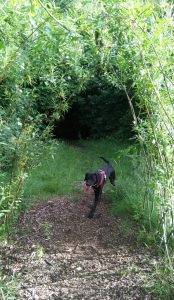
    In Victoria Park there is a willow tunnel.  I like to walk through it.  I consciously enter it from different ends on different days, just as I try to actively consolidate new pathways in my mind.  Sometimes Nomar runs through it with me and other times he is off doing his own thing, usually weaving around trees, looking and sniffing for sticks, his tail zigzagging in all directions.  We move apart and we come together, with synergy, unspoken (mostly), without effort, like a dance.  The willow takes me back to the farm and the old willow tree we had in the garden, which I used to sit under and ‘talk to the fairies’, apparently.  It seems I had a relationship with trees from a young age and it is no wonder that I now seek out their containing, awe-inspiring and nourishing comfort.  I have begun to bring the more magical aspects of childhood into my therapy, as the grief at leaving the farm lessens. 

    It feels important now to share some of this, and to begin to think about what I might share about my childhood with my own daughter.  I wonder, also, how to start bridging the gap between my somewhat idealised childhood and my current adult life. Much of the pain is in-between. Very little about my childhood has been discussed by my parents since they broke up, at times it feels like it never existed and has taken on a sort of mythical quality.  The willow tree in the garden was cut down because the roots were too close to the house, where does that sit in my ‘tangled ball of grief’ (2)?

    The first time I lived on my own, at age 18, my drinking problem was escalating. I experienced frightening, intrusive thoughts and images most nights and kept a baseball bat under my pillow. Somehow I got through my A Levels but didn’t achieve my predicted grades and therefore didn’t get onto my chosen degree course. I took a ‘gap year’ which involved staying in Hereford, getting whatever jobs I could, and after work – spending a lot of time in the pub drinking cider, eating pork scratchings and playing pool with older men, with their dogs as witnesses. I was especially fond of ‘Skippy’ the Whippet. I would later visit the 24 hour Tesco close to my flat on the way home from a nightclub.  As well as ‘munchies’, I would often buy plants in my drunken and stoned state and I remember once introducing a coconut plant to the willow tree on the roundabout, as I neared my flat.  I was with a friend and there was much hilarity generated by this midnight arboreal encounter.  At the same time though, and in hindsight of course, something deeper was at play.  Trees are considered sacred in many cultures and some humans have a sense that trees are sentient beings, emitting a vibrational energy upon contact, and through their deep roots, carrying powerful grounding energy.  Trees represent connection and cycles of life.  I pasted an article into my journal a few years ago about the history of Victoria Park (3) and circled the following section,

    ‘So many trees were planted that in 1907 the Bristol Ratepayers complained about the cost.  But the many limes, oak and plane trees have given the park its character, and whenever one has to be felled because of age or disease, people mourn or even protest at their loss.’ 

    This post doesn’t feel finished… I keep coming back to it again and again. I can’t work out how to finish it. Maybe that’s the whole point? Although shouldn’t I be saying this for ‘Unfinished Business’?

    © 2021 Psychodography Blog

    REFERENCES

    1. Yalom, I.D. (1991) Love’s Executioner: And Other Tales of Psychotherapy.  Penguin.
    2. H. Norman Wright (2014) Experiencing the Loss of a Family Member. Bethany House, a division of Baker Publishing Group.
    3. South Bristol Voice (2017) The Story of Victoria Park, 30-33.
  • ‘Begin within’

    ‘Begin within’

    This is a dabble with psychodography; combining psychogeography and dog-walking.  An attempt at an autoethnographic study of self-discovery, trauma-recovery and balance, as a new counsellor negotiating a multiplicity of emotional demands.  I’d like to tell a story of mindfulness, movement and modulation with my dog as my steady companion and witness.  I’ve come to realise, this is perhaps a process of phenomenological inquiry. It is certainly experimentation and it was, initially, an interweaving of three main theoretical approaches which have influenced the process; Heinz Kohut’s Self Psychology (1,2), Jennifer Jane Johnson’s research into well-being gained through relationships with companion animals and Babette Rothschild’s Somatic Trauma Therapy.  These are some of the books I read whilst studying for my Counselling Diploma.

    My connection with animals and the outdoors was an essential part of my ‘secure base’ as a child.  The grounding qualities of this sharply came into focus during the overwhelming expedition of training to become a counsellor at the same time as still being a relatively new mother.  Johnson suggests, ‘Factors in people’s lives that might provide a buffer, or relief to distress, are worthwhile investigating…the human-animal bond merits attention in counselling training, research and practice’.  During my training I inevitably had to face loss and trauma from my past and needed to learn how to dip into it in a manageable way so as not to become overwhelmed; putting into practice my mindful gauges and grounding tools by drawing from Rothschild’s ‘8 Keys to Safe Trauma Recovery’ (3). This has helped me to explore effective self-care techniques for me and experiment with various modes and methods of capturing my experiences out walking, with the “constant positive presence” (4) of my dog.  These all inform my pursuit of a healthy balance between re-visiting my past and staying grounded in the present, unearthing power from vulnerability and encountering what it might mean to belong.

    I read a Psychogeography article by Chris Rose called ‘Walking Together’, in the BACP magazine, Therapy Today. This initially gave me the clarity I was seeking for the project I was embarking on.  From reading this, to then discovering the book ‘Walking Inside Out’ by Tina Richardson (5), I experienced a fresh nostalgia and jubilation when I read the chapter ‘Walking the Dog (For Those Who Don’t Know How to Do It)’ by Ian Merchant; set in my childhood county of Herefordshire.  In homage to the early 1950s Parisian Psychogeography movement, Merchant seeks to achieve an altered state of consciousness in his familiar surroundings, which he does by smoking a spliff – before walking his dog around the village.  For some, Psychogeography is focused on the local area, for others it is about exploring somewhere new without a plan or even necessarily a map. It is the perfect activity for me, because I love walking and I’m really good at getting lost! I don’t even need to smoke anything to help with the latter.

    I realise there are others who share my penchant for documenting the qualities of dog-walking, or walking and talking, or simply walking.   I no longer assume that this is just a strange thing I am doing on my own; a familiar feeling as a child roaming the fields alone talking aloud. Or sometimes with my cat following me, until he found something more interesting to do, like guarding a rabbit hole.  

    I have been inspired by and found some parallels with Devika Chawla. This was my first encounter with autoethnography and I highly recommend her captivating website, ‘Rhymes, Reasons, & Ramblings’.  In ‘Walk, Walking, Talking Home’ (6) she evokes such a rich sense of space, place, movement, contrast and loss, that I almost feel I can touch it.  Like me, she has also spent time in the United States and compares her walking experiences there, with those in her small north Indian home-town in the Himalayas. 

    Experimenting with walking (and writing), and reading about others doing the same, has become a form of self-care and self-discovery for me. I’d like to emphasise approaches to trauma recovery, and self-care in general, which do not involve reliving the past; either in the form of intrusive thoughts or de-stabilizing interactions with a therapist or therapy/personal development group. It feels immensely important to further raise awareness of the risks around re-traumatisation for both counsellors and clients. 

    I want to also highlight that mindful meditation does not have to involve sitting still; not helpful for everyone, as Rothschild accessibly explains in ‘8 Keys to Safe Trauma Recovery’.  These are steps towards personal integration, particularly in striving to soothe my internal urban/rural struggle, ambivalence about trust and intimacy, balancing vulnerability and power and yearning for a sense of ‘home’.  From at first plotting my course with mindfulness, using Rothschild’s ‘KEY 1’ as a guide, I have drawn further strength and resolve from ‘KEY 3: Remembering Is Not Required’ and crucially ‘KEY 7: Get Moving’. 

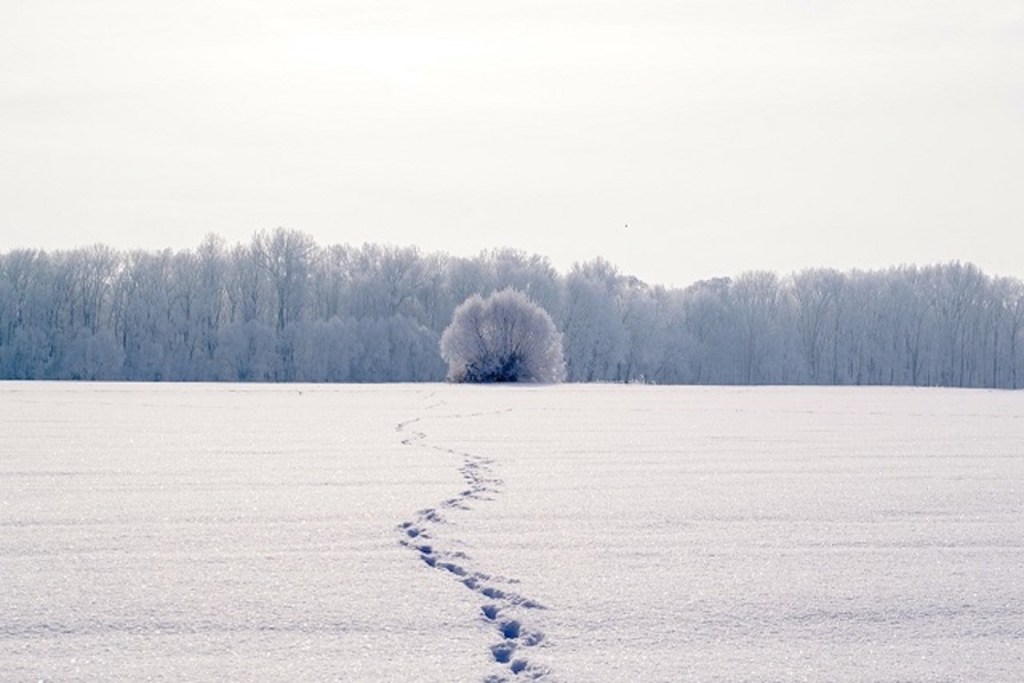
    ‘As we ‘walk alongside’ the client, we travel through internal landscapes of desired utopias and feared hells… to find new pathways through old and scarred territory.’ (7) It is new pathways that I pursue for myself, whilst co-creating new tracks through old terrain with clients, like sheep tracks trodden repeatedly into hillsides.  Long-term placement clients I worked with have courageously sought therapy for their battle with addiction and traumatic past. I am reminded of the ‘shaky ground’ Gerhardt (8) describes in ‘Why Love Matters’; the effects of too much cortisol in early life, the relationship between dopamine and processing of reward and punishment and how this is inextricably linked with drug-taking, or other self-soothing/self-harming strategies (9). One client was searching for ‘fresh footprints in the snow towards a safe, cozy cabin’. It was a privilege to witness this journey, walking alongside the client as much as I was able, and the vividly lucid image has stayed with me ever since.

    Similarly to Rose’s article, my expedition draws together many things, the essence of which is relational.  Relationship with self, relationship with place, relationships with others; strengthened, re-considered, re-kindled, or new ones founded, through this new way, for me, of approaching self-development.  The ‘fresh nostalgia’ mentioned earlier is beautifully summed up by Rose; ‘Encountering psychogeography is simultaneously like greeting an old friend and discovering a stimulating, quirky, innovative and challenging new acquaintance.’  

    To ‘Begin within’ (10) is to set the scene of my internal world and the journey I have enjoyed and endured and was necessary, for me to start stepping out – facing the world in all of its beauty and ugliness and everything in between. All of its challenge and struggle.

    I want to thank my wonderfully creative and intuitive, integrative counsellor for fervently reflecting and re-reflecting my need for space, movement and quality time with my dog.

    © 2021 Psychodography Blog

    REFERENCES

    1. Kohut, H. (1972) Thoughts on narcissism and narcissistic rage.  Psychoanal. Study Child 27:360-399.
    2. Kohut, H. (1977) The Restoration of the Self.  New York: Int. Univ. Press.
    3. Rothschild, B. (2010) 8 Keys to Safe Trauma Recovery: Take-charge Strategies to Empower Your Healing. W.W. Norton.  New York.  London.
    4. Johnson, J.J. (2015) ‘The experiences of pet owners’ well-being gained through their relationships with their companion animals’ in Listening To Less-Heard Voices: Developing Counsellors’ Awareness, edited by Peter Madsen Gubi.  
    5. Richardson, T. (Ed) (2015) Walking Inside Out: Contemporary British Psychogeography.  London: Rowman & Littlefield.
    6. Chawla, D. (2013) Walk, Walking, Talking Home. Rhymes, Reasons, and Ramblings.  Retrieved from https://devikachawla.wordpress.com/
    7. Rose, C. (2016) Walking Together, Therapy Today, 22-25.
    8. Gerhardt, S. (2004, 2015) Why Love Matters: How affection shapes a baby’s brain.  London/New York: Routledge.
    9. Aaronson, R. (2006) Addiction: This Being Human. Authorhouse.
    10. Saad, L. (2020) Me and White Supremacy: How to Recognise Your Privilege, Combat Racism and Change the World. Sourcebooks.

  • The Experiment

    The Experiment

    ‘Psychogeography does not have to be complicated.  Anyone can do it.  You do not need a map, Gore-Tex, rucksack, or companion.  All you need is a curious nature and a comfortable pair of shoes.  There are no rules…’ (1)

    So what is Psychodography?  I journeyed to the Jurassic Coast with my dog, anxious and guilty at leaving my two-year-old daughter – albeit with her capable and conscientious father – for the weekend, but with a ‘curious nature’ waiting in the wings… stayed in a VERY dog-friendly B&B; with a surprising field dedicated to dog agility training… found a dog-friendly (enough) pub for dinner… got back to the room and flicked through crap telly thinking about what the fuck I was doing there.  After a sea view breakfast I asked the host for a map of the area onto which she highlighted the closest circular walk… set off to find the sea, in my Gore-Tex coat and rucksack, with my canine companion, and promptly got lost.  After all… there are no rules.  

    I began to record my voice with a Dictaphone. including shouting from the top of the cliffs; where I ended up after getting lost and after the dog had rolled in shit.  I felt safe and free enough in Dorset to start experimenting.  Listening back to my recorded counselling sessions in the preceding months had felt so excruciating at first that I decided to experiment with various ways of capturing my thoughts, feelings and experiences and get more used to listening back to my own voice.  I think this exercise has also become part of the movement I was seeking, a kind of emancipation of voice, and something I continue to do, on occasion, whilst dog-walking. 

    To give a few examples of the content and my experience of listening back to it; I sound tentative and unsure, childlike, whilst the sound of my footsteps on the ‘crunchy November leaves’ seem much more assured.  Settling into the walk, I say with an exhale, ‘starting to feel the space now’.  I mention that the B&B lady’s lisp reminds me of my own lisp throughout childhood and being told of the more severe speech difficulties I had early on.  I am struck by the stifling frustration that surges in me when I do not feel understood or get stuck for words.  I am caught up in my thoughts.  And then notice my dog,

    ‘Aaah, Nomar’s standing up on the hill, on the silvery frosty grass… completely still, with his back leg… OH! He’s running (pause) he’s running he’s running he’s running towards me.  Hello! You looked magnificent!’

    My voice is fast and I feel excited and happy listening to it, I notice the change in my speed and tone and focus reflecting the quality of my dog’s running and I now recall the fulfillment of wellbeing (there must be a better word than this!) in the experience of him running back to me.  

    Extracts of the recordings include a louder, more urgent sounding voice, swiftly getting Nomar on the lead as we were passed on the cliffs by a running herd of sheep, and contrasting with my enthralled teenage sounding voice, with dropped consonants, as I recount the ‘lady farmer…bezzin’ past…on a quad bike’ and her three sheep-dogs running close to the ground alongside.  I have a rousing curiosity about powerful women… and the sheep are Badger-Face Welsh Mountain Sheep, which have long been favourites of mine.  They are striking and confident and seem very relaxed around dogs, Nomar came almost nose to nose with one.

    I grew up on the border of Wales and we had sheep on our little farm.  In fact, I had a pet lamb called Sally who had been rejected by her mother.  I took her for walks on a lead around the village.  The black and white Badger-Face sheep has become one element of my ‘Configurations of Self’ (2) in therapy, representing my desire to ‘fit-in’ and be one of the crowd, but at the same time longing to feel secure in my difference and individuality.  

    In the early stages of voice recording, I became aware of just how prevalent my inner critical voice still is, having spent many many hours and money in therapy working on this over and over again, over the years. Then the stark contrast between outwardly voicing what is going on in my head, compared with what I notice externally in my immediate environment in the moment, and how I feel in response:  A sort of self-directed phenomenological inquiry (e.g. Joyce and Sills, 3).  I have latterly steered towards the philosophical phenomenologist Maurice Merleau-Ponty to help inform this process and re-discovered Heidegger and Sartre.  Thank you James (dissertation tutor).  I experience many ‘Authentic moments’ walking with my dog, moments described by Heidegger as ‘those in which we are most at home with ourselves, at one with ourselves.’ (4) 

    Back to powerful females: Another ‘Self’ I feel connected with is a girl with an eagle, inspired by a newspaper article about the documentary ‘The Eagle Huntress’ (5); about a 13-year-old Mongolian girl with a ‘near genius for working with the eagles’ even though the ‘elders grumble that women are too “fragile” for such an arduous business’.  I know nothing about hunting with eagles, but I do feel I have an affinity with animals and this brings out my courage, strength and assertiveness, in contrast to my (reducing) tendency to be passive, even submissive, with other humans.  I do have a ‘fragile’ Self too; a small frog with hidden emotions, defended, constantly adapting myself for others, often suffering in silence (or hiding in silence?).  I recall feeling completely powerless at times in the past, my boundaries traumatically invaded on occasion.  Yet, high up on the cliffs of the Jurassic Coast, I connect with that courageous girl, at one with her powerful companion animal.  Vulnerable out in the open, safe with my dog.

    As I relaxed into the weekend, I recorded less of my voice and more of the sounds of walking; on the crunchy leaves, grass, pebble beaches, paddling in the sea and the lovely contrast between my somewhat dogged – pardon the pun – footsteps, and Nomar’s whimsical padding around all over the place.  After this, I sounded much calmer on the voice recordings, with no conflict, no judgement.  

    I accidentally recorded my whole journey home – the Dictaphone left on in my pocket; the final walk back to the B&B, packing up the car, driving and singing along to 90s rock and grunge, getting back to an empty house. Then… the murmur of the radio, the click of the kettle, and shortly after, my husband and daughter arriving home from the park and the heart-warmingly familiar greetings between us all; aware more than ever of the gratitude and comfort these small details evoke, of what it means to be ‘home’. 

    I recall an article, ‘the healing power of the ordinary’ by Gretchen Schmelzer (6), with a picture of a sleeping dog and a basket of laundry.  It is about trauma recovery and the healing power of everyday, ordinary experiences and seems to fit with the ‘ordinary, everyday, experience’ of a ‘phenomenological approach’ (7).  

    Daily routine and rituals, including walking the dog of course, have become integral to me staying within the ‘window of tolerance’ (8).  Schmelzer also writes about the courage of parenting with a history of trauma; meeting your own voice; the ‘healing fog’.  I also came across, ‘Trauma makes you live in ‘backwards world” and wonder if this is why walking forwards feels so important.  It sometimes feels like an upside down world for me too.

    © 2021 Psychodography Blog

    REFERENCES

    1. Richardson, T. (Ed) (2015) Walking Inside Out: Contemporary British Psychogeography.  London: Rowman & Littlefield.
    2. Mearns, D. & Thorne, B. (2007) Person-Centred Counselling in Action (3rd ed.). London: Sage.
    3. Joyce, P. & Sills, C. (2014) Skills in Gestalt Counselling and Psychotherapy (3rd Ed).  Sage. 
    4. Moran, D. (2000) Introduction to Phenomenology.  New York: Routledge.
    5. Macnab, G. ‘The Eagle Huntress’. Review of The Eagle Huntress, directed by Otto Bell. The Independent, Dec. 2016.
    6. Schmelzer, G. (2014, 2016) http://gretchenschmelzer.com/ 
    7. Silverman, D. (2010) Qualitative Research (3rd Edition).  London, UK: Sage Publications.
    8. Siegel, D. (2009) Mindsight – The New Science of Personal Transformation. NSW Australia: Scribe Publications.
  • Unfinished Business

    Unfinished Business

    Arnos Vale Cemetery and Arnos Park are probably the most frequently visited places with my dog.  It is also where I go to feel sad.  It seems ok to be sad in a cemetery.  The cemetery, in parts, has been reclaimed by nature; overgrown, with wonky, cracked gravestones and an impressive variety of plants and wildlife including rare Lesser Horseshoe bats.  It is here that I started using the very rudimentary ‘notes’ application on my phone to capture some of my thoughts and feelings on these walks, along with what I was noticing in my surroundings, in the present moment.  My first notes refer to painful, complex feelings and at the same time a sense of simplicity, which is a theme that re-emerges time and time again.  Around this time, my therapy and journal writing kept re-visiting ‘power’.  I had a small section of my hair dyed red and tore out an article from a magazine at the hairdressers, called ‘The Power of Pets’ (Tracy Ramsden, Marie Claire – November, 2016), with a bold picture of an English Bull Terrier called ‘Neville’, dressed in an ornamental red coat.  

    As an aside, I’m just reading back through this section a few years after first writing it and having a chuckle to myself – the other day my daughter (now age 6) said, ‘I wish I had a Neville on my shoulder whispering what to do when I’m bored’. She was referring, I assume, to the Devil whispering into Little Billy’s ear in the Roald Dahl story, ‘The Minpins’. I too loved that story as a child and could often be found chattering away to tiny people in the trees. This also reminds me of a Gestalt ‘experiment’ I did in the early days of counselling training when we were practising being ‘counsellor’ and ‘client’. I was the ‘client’, and the ‘counsellor’ pointed out a gesture I was making repeatedly towards my shoulder – I said it was like there was a devil on my shoulder, my ‘critical voice’, and I was invited to give it a persona. What sprang to mind was Dick Dasterdly from Wacky Races. A few days later I was walking down the street and the ‘devil’ showed up again on my shoulder. I imagined a giant hand – Monty Python style – flicking the tiny Dick Dasterdly off my shoulder and sending him bumping along the pavement. And so my ‘critical voice’ had lost its power, a process which has come a long way but still requires regular attention.

    Back to Neville though. In the magazine, Ramsden mentions a psychotherapist, Wendy Bristow, who is quoted saying that pets represent the dependent, pre-verbal stage of an infant and that Freud was a great dog-lover and believed the relationship was about affection without ambivalence.  I reluctantly include a Freud reference, but it does seem particularly relevant.  Bristow suggests that we can see our pets as therapists and dogs can ‘read’ the right side of our faces, which express emotions more than the left ‘poker face’ side.  I recall a hairstyle I had as an adolescent, where my hair literally covered the right side of my face.  Furthermore, many people have told me I have a good ‘poker face’.  Hiding my emotions felt necessary in the past I think; not long before this, my father had left my mother and we had all left the family farm.  My life was altered beyond recognition and a double trauma followed when I was 15.  I resorted to regular binge drinking for the following 15ish years and realise now that I had become fairly adept at dissociating.  

    Keeping in mind Rothschild’s KEY 3 – ‘Remembering is Not Required’ (1), I choose not to recount here what happened when I was 15.  I have addressed it in therapy for many years and continue to do so in a much more containing way, so as to remain grounded in my present life.  I somewhat forgot about the nourishing natural environment during my troubled adolescence – I’m sure this is pretty common though – and keeping pets around that time was not very successful.  I have now returned to the outdoors and our relationship feels so much more salubrious and symbiotic, as I consciously cherish every tree, leaf, flower, meadow, cliff… and the earth and elements in turn reflect my capacity for balance.

    During December a few years ago, I dreamt about a cave with light at the other end.  That day I had noticed the last leaves falling, the fluttering movement and also the drifting clouds, the motion of my walking feet, the cool breeze, and in contrast – the stillness.  I remembered the vivid red leaves of autumn. I took photos of Nomar lying in the sun and thought about fire.  Since then, I have lit a candle every night before bed as a symbol of each day ending, a time to stop and rest, but still with the comforting movement of the flames.  January’s bright frosty walks led me to consider the importance of balancing light and dark and I took pictures of our shadows against the glistening ground.  I looked forward to spring and the pink tree.

    I began to explore what my relationship with my dog means.  Am I projecting some aspect of myself onto him, I wondered.  I considered various possibilities; a recognition that Nomar feels both like a parent and a child and sometimes a more equal companion, when he is running free off the lead and we are enjoying the space together. After my daughter was born, Nomar would patiently wait for his walk, lying on my feet while I fed her.  He was my “constant positive presence” (2) in those early stages of sleep deprived, overwhelming, de-stabilizing parenthood.  He looks after me and I look after him. 

    This led me to recall my childhood dog, Lucy, and during a walk I tentatively texted my mother to ask what she remembered about Lucy’s death.  There was an article ‘Voice, trauma and voicelessness’ in Therapy Today (3) and the predominant theme that the voice can be affected or even disappear in response to bereavement; from the grief, shock and trauma.  Lucy was always there throughout my early childhood, guarding the pram, waiting at the bottom of the stairs, uncomplicated and present.  She died when I was 7.  

    Beck and Katcher (4) emphasise the emotional and developmental benefits of companion animal relationships and hence, there seems a complex nature to their loss (5).  I think I have superfluous grief from childhood, perhaps it was not well held or contained (e.g. Winnicott; Bion; 6,7).  The ultimate loss of course was the breakdown of my family, leaving our family farm and re-homing most of the animals.  So many enriching relationships with animals and so much unspoken grief. 

    I do not always feel sad in the cemetery. My daughter joins us on lots of walks and we play hide-and-seek, or pretend we are on a bear hunt.  The playfulness balances out the more sombre, unsettling, disturbing or intense feelings and memories that called to be processed on the swamp-dredging counselling course.  In ‘The Myth of the Untroubled Therapist’, Adams (8) states, ‘it is almost a presumption that those of us who choose to become therapists are not people who have sailed through life.’  When I tried to express my struggles and fears as a new mother entering counselling training, a key person in my life said something along the lines of, ‘you seem to find this so much harder than other people do… I just seem to have sailed through life’.  Enough said about that for now, I notice myself spiralling out of my body and shutting down with ice cold rage, my muscles tensing, my mind clouding over.  Back to nature and the dog; ‘leaves, leaves, leaves… content among the crunchy colours’.    

    Some days we leave the cemetery and trudge along the river; juggling dog-walking and buggy pushing, without child in buggy of course. Said child instead brandishing large stick or climbing anything in sight. And me, attention pulled in several directions, trying not to crash into cyclists.  An abundance of nature is sandwiched between the ongoing construction of new flats, and on the other side, industrial buildings and the dogs’ home.  To my left, Clematis Vitalba (Old Man’s Beard) grows prolifically amongst many other plants I do not know the names of, and I see wagtails, moorhens, ducks, geese and cormorants. Word has it, there is also a heronry further along the river.

    To my right, my eyes are drawn to graffiti and barbed wire and overflowing drains.  In particular, there is some graffiti which reminds me of the first thing a counselling client said to me, ‘I feel like a fraud’. I also feel like this sometimes. Further along there is a graffiti ghost – to me it looks like a ghost anyway – which sparks my wavering memories of ghost encounters at my childhood farm.  A few years ago, my mother told me that areas of the farm had been ‘exorcised’, yet I feel that my ghosts remain there and keep trying to drag me back with shadowy hooks.  I did not properly say goodbye.  My ambivalence about Herefordshire is undoubtedly associated with ‘unfinished business’ (e.g. Perls; 9). This is shifting all the time though, as I learn to create movement in my mind through imagery, as well as literally keeping my feet moving forwards.

    Herefordshire is a beautiful county* and I always feel a pull to go back, yet the underlying sadness associated with the place often wells up and knocks me off course; as accessibly described in ‘The Presenting Past’ (10), one’s past is ever present, influencing the dynamics of all relationships; with self and others, throughout life. It feels safer and more grounding to process my sadness in Arnos Vale, closer to my current home.  On one visit to my mother and step-father in Herefordshire, I read through Johnson’s companion animal chapter in ‘Listening to Less Heard Voices’, with Nomar lying on my feet as usual, and found this a comforting focus.  I identified with the themes; the bond that can occur if a companion animal is present through periods of personal change or growth, a constant witness. Along with themes of self and enrichment, healing and transformation, identity and beliefs, and the tactile quality of the relationships.  Physical closeness between people is complicated, especially if boundaries have been violated in the past, whereas touch with an animal often has a very different quality; ‘the contact… the cuddling and playing’ (said a participant of Johnson’s research).  

    I feel the theme of ‘presence’ is the most relevant for me, and included within this, the idea of filling the spaces and using the senses.  Linking again to Rothschild; it is often when there is space that intrusive memories emerge from the depths.  I now practise filling the much needed space, not with draining, introspective, disorientating rumination and intrusion, but with a more aware, outward connection to my present existence and environment.

    Sable (11) claims that companion animals ‘…furnish a component of attachment that promotes well-being and security’, hence the lasting impact of their loss.  Barrows (12) goes further to urge a new child development theory of an ‘ecological self’, encapsulating a sense of belonging to something larger than the nuclear family and the materialistic culture into which they are born.  She writes, ‘The infant has an awareness not only of human touch… but of the touch of the breeze on her skin, variations in light and colour, temperature, texture, sound…’.  Is this what I am re-connecting with?  There were huge incongruences in my upbringing; a jarring between corporate materialism and striving for the ‘good life’, which dwindled over time, finally falling apart.  I can’t deny the richness and resilience I have gained from these formative experiences of connecting with animals and the outdoors, yet it was a confusing concoction all the same. Jordan (13) argues that for many, there is an ambivalent attachment to nature.  I think my ambivalence is more to do with people, including myself.

    I take videos whilst walking in the rain and search for any comfort I can find in the outdoors, anything solid to hold onto to settle my mind and gut, as I continue to tackle the emotional demands of both counselling training and learning how to be a parent.  Maybe lots of people stay indoors and get cosy when it’s raining. I assume this because there are fewer people about. But I have to go out and so does my dog.  On one day, this was the best I could come up with, ‘The leaves on the ground are all turning to mulch…like what’s happening in my mind’.  I relate the potential and fertility of the ‘mulch’ to qualitative research; trusting that it will bring new life to something that may seem murky and inaccessible at first, with no clear paths through it, that I might slip and fall on my arse now and then and I can pick myself up and keep going, holding onto some branches along the way.   

    I notice magical, shiny droplets on the exposed winter branches and imagine they are miniature glass houses for fairies.  I also realise that the birds still sing when it’s raining.  There is a different kind of beauty and comfort on a rainy day, I would be missing out if I stayed indoors.  


     *Just to add in relation to Herefordshire, for those into walking, I recommend exploring the Black Mountains, even if just to say you have walked along the ‘Cat’s Back’ or climbed ‘Lord Hereford’s Knob’.

    © 2021 Psychodography Blog

    REFERENCES

    1. Rothschild, B. (2010) 8 Keys to Safe Trauma Recovery: Take-charge Strategies to Empower Your Healing. W.W. Norton.  New York.  London.
    2. Johnson, J.J. (2015) ‘The experiences of pet owners’ well-being gained through their relationships with their companion animals’ in Listening To Less-Heard Voices: Developing Counsellors’ Awareness, edited by Peter Madsen Gubi.  
    3. Dennett-Short, T. (2016) ‘Voice, Trauma and Voicelessness’, Therapy Today, 14-17.
    4. Beck, A.M. and Katcher, A.H. (1996) Between Pets and People.  The importance of animal companionship.  (Revised Edition).  West Lafayette, IN: Purdue University Press.
    5. Stewart, C.S., Thrush, J.C., & Paulus, G. (1989) Disenfranchised bereavement and loss of a companion animal: Implications for caring communities.  In K. J. Doka (Ed.).  Disenfranchised Grief.  Lexington, KY: Lexington Books.
    6. Winnicott, D. (1960). The theory of the parent-child relationshipInt. J. Psychoanal., 41:585-595.
    7. Bion, W. (1962). Learning From Experience. London: Karnac Books.
    8. Adams, M. (2014) The Myth of the Untroubled Therapist: Private life, professional practice. Routledge.
    9. Perls, F.S. (1969) Gestalt Therapy Verbatim.  Moab, UT:  Real People Press.
    10. Jacobs, M. (1986) The Presenting Past.  London:  Harper and Row.
    11. Sable, P. (2013) The Pet Connection: An Attachment Perspective.  Clinical Social Work Journal, 41: 93-99.
    12. Barrows, A. (1995) The Ecopsychology of Child Development. In T. Roszak, Gomes, M. & Kanner, A. (Eds) Ecopsychology: Restoring the earth, healing the mind.
    13. Jordan, M. (2009) Nature and Self – An Ambivalent Attachment? Ecopsychology, 1 (1), 26-31.