As a child I wrote a lot of stories. I don’t know where they are now – I think they got lost in the mess of parental divorce and multiple house moves. I think I got lost too.
In therapy and on dog walks and with writing (hour by hour, week by week, walk by walk, page by page) I have been finding the pieces of myself and inviting them to come back together again. Digging out the old stories… not physically finding the originals written on paper, inscribed into primary school exercise books… but locating the ones in my memories, the ones etched into my body and senses; liberated, a little more, every time I plod the perimeter of a field or meadow, pause to pay attention to birdsong, breathe in the dewy moss. Stop – sit – close my eyes and welcome in the images of the past… and ask what they’re trying to tell me…
One story in particular sticks out in my memory, it probably went a little something like this:
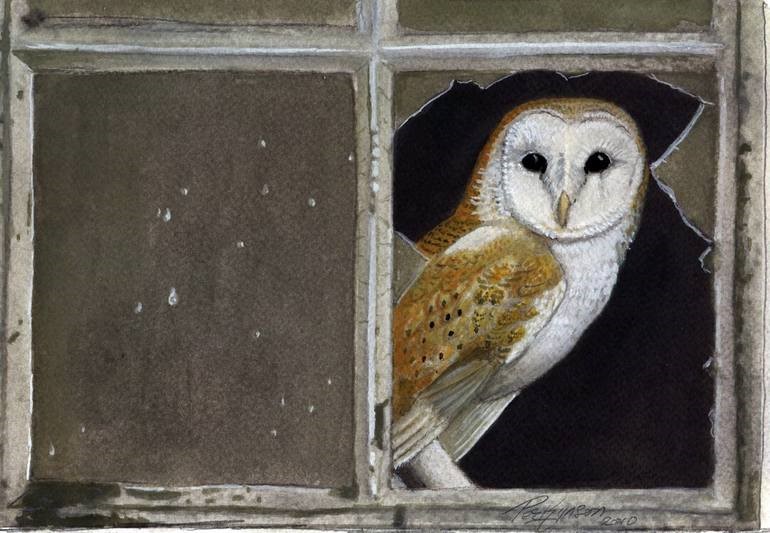
Once upon a time...there was an old painting of a farmhouse and a barn owl. This painting was in a cottage, where a little girl lived. She would walk past the painting, which was hung in the hallway, and would stop to gaze at it every day. She began to notice that each year, as she grew older, the owl would also look older and would move to different positions in the painting. At first, the owl was in a cherry tree next to the farmhouse, then the next year it had moved to thegatepost, thenit sat on the stable door, then perched on the edge of the wheelbarrow. The girl grew bigger, and older, each year, moving through her childhood, and the owl moved with her. In her eleventh year, the girl became gravely ill. She insisted on struggling down the stairs each day to see the painting, her mother and grandmother either side of her, holding each arm. The owl moved from the roof of the farmhouse, to inside, peering out through an upstairs window, looking extremely old. Eventually, the girl was no longer able to leave her bedroom. Her family were very worried, and feared the worst. They sat by her bedside every day. After she turned twelve, the girl became fretful and strained to speak. Her mother could only just make out the words, "The owl, where is the owl?" With her last breath, she murmured, "The owl in the picture". In her grief, her mother forgot all about the painting and the owl, until they were moving house and packing up the belongings. She stood in the hallway in front of the painting, about to take it down, but paused and stared into it. The owl had vanished completely.
‘We trust the page as a source of authority’, Clare Murphy says. While I tried to tell the owl story, I realised, with regret, that I couldn’t remember it very well at all. I am sure, therefore, that I have omitted and elaborated, rather a lot. I don’t remember, really, if the girl died, but I imagine there was a death of some kind, in this one of my many ‘morbid’ stories. There usually was. Stories help us to know ourselves and where we have come from; historically, personally and spiritually. We can grow through stories – telling and listening and sharing – and it helps me to not stick rigidly to the script, as I once did.
I wonder if anyone would want to listen to me tell my stories from the farm, what I remember of them, and what has been embellished. I have been stubbornly, guardedly, dependent on pen and page for as long as I can remember – keeping it all to myself, for the most part (except for the odd teacher, oh and letters to childhood ‘pen pals’ – I nearly forgot). Secret or not, writing has been a lifeline for me. Then I discovered relational risk-taking. The existence of an academic term for this, somehow gives me permission to take those vulnerable, exposing risks in relationships. Some, relationships.
Thanks to my ever present and trusting therapist, in recent years I have gained the confidence to read my writing out loud, to another, live, human person! I have a voice, and now I share it. Healing and healing and healing… from experiences that rendered me voiceless, powerless. I feel I am learning to talk, all over again, and learning to really, truly, listen. Learning to speak the truth about loss, and love. Learning to listen to those who I feel have taken up too much space in my mind, and tentatively trying to speak truthfully, to them. Learning to share experiences of living in Wales, and in the borderlands between Wales and England, with those I feel judged by; bridging generational and cultural gaps. I have important stories to tell, and so do they.
Vocal steps are being taken, small vociferous risks, gaining in strength and volume, pacing steadily up a mountain with each exhale, with every story, with every stride. To one day SHOUT from the top. A primal scream. Echoing through the valleys and caves. Meanwhile, recognising the safe and gentle places, spaces, people… when they appear – offer sanctuary – and learning to meet them in kind.
In some cultures, the stories tend to remain largely unchanged by the master storytellers and their apprentices, for example, in the ancient art of Rakugo in Japan, although apparently this is changing. Native American culture is also known for its rich oral tradition. ‘Each time a story is told, it breathes life into the culture… Their symbiotic connection to the earth and intimate relationships with the animals they depended on is also depicted through storytelling… often forcibly relocated to land that was not their own. Their customs, language and religion were ways for them to remain connected to each other and their homeland’; https://allgoodtales.com/storytelling-traditions-across-the-world-native-american/
I imagine families and communities from long ago, huddled around a fire telling stories. This is coming back, so I’m told, and plays a crucial part in the attempts to protect our natural world and our relationships with it and within it. I’m familiar with the Celtic storytelling traditions, although only just consciously recognising their value. I am also very drawn to Icelandic storytelling, with its ‘hidden people’ (do I actually remember ‘talking to fairies’ under the willow tree as a young child?). I visited Iceland towards the end of the pandemic, and experienced a profound connectedness there, as well as a powerful release of grief.
It is the end of winter in the UK, and finally it’s not so dark or cold! Though I’m sure the Icelanders would have something to say about me moaning over a ‘long’ winter.
Picture Icelanders living in turf longhouses sitting around smoky fire pits sharing stories and reading aloud to one another. Ancient myths, heroic quests, tragedies, comedies and lessons in life were all depicted in their traditional stories to keep spirits high… The stories of antiquity are allegorical accounts that teach their audience to respect both the spirits of the land, and the natural environment in which they reside…
A picture of course, can say a thousand words. But I’m no artist, so I’m sticking with the writing, and working on the speaking, and changing the script. And what if I change the owl story again, or write different versions of it? Alternative endings? I can do that, if I want to, it’s my story. What if the girl lives? A new, miracle, treatment is discovered! Nevertheless, the girl would have gone through a metamorphic experience – survived a terrible illness – been ‘at the edge of the everyday world’ (https://arnolfini.org.uk/whatson/previewrinkokawauchi/) and come back, changed, a tacit transformation, like the start of spring (which always takes me by surprise).
Maybe she would want to leave the farmhouse, perhaps live in a tall townhouse on the edge of a cosmopolitan city. She wouldn’t see barn owls anymore… or perhaps would – she could visit Granny in the countryside, even go to an owl sanctuary together! And what of the owl in the picture… would it disappear anyway?
Dig deep, linger longer, tell stories, make alliances.
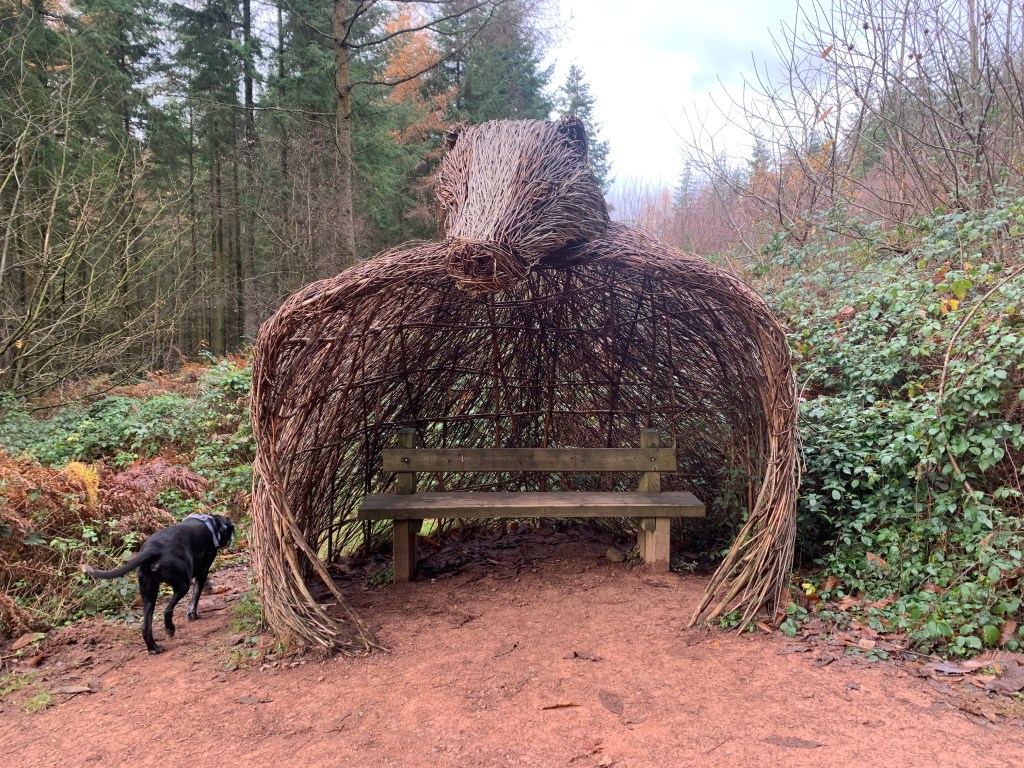
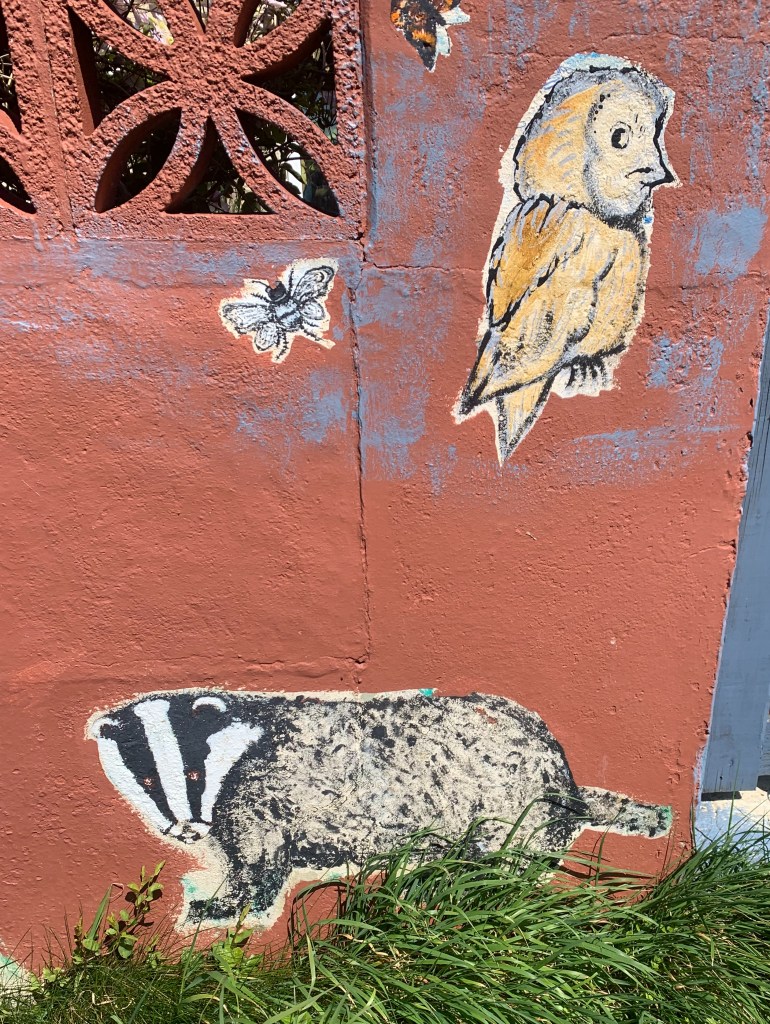
Sometimes small things seem like big things and big things disguise themselves as small things, and we become obsessed with badgers (maybe that’s just me!)
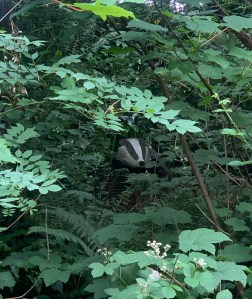
My aim this autumn was to write something that’s light and quirky, with no particular agenda (other than badgers), and see what happens… and ideally, not focus on death. Then I saw a dead badger at the side of the road. The irony is, I haven’t seen a real live badger since 2008. It was waddling/scurrying quickly up a road near Alexandra Park in Bath, UK. What’s a waddle scurry? A wurry? It did seem worried. It also seemed to be struggling with the weight of it’s own body (I felt like that trying to get out of bed early this morning).
‘Badgers appear rather plump, but this is not fat. Rather, it’s muscle mass, and the creature is formidable if need be.’ This year I’ve taken long overdue steps to try to increase my muscle mass (advised by my therapist nearly 10 years ago). ‘Combine this with a powerful jaw, and you have a creature that can stand its ground when necessary.’ However, ‘…would rather find safety than fight, but if they’re cornered, they know their assets and use them effectively; this makes Badger a powerful ally when you are developing new attributes and endeavouring to increase self-sufficiency.’ (1)
Is this why I’ve been noticing badgers everywhere since deciding to become self-employed?
‘We’ve all heard the phrase, “Stop badgering me!”'(2). Badgers are considered tenacious, diligent and hard-working. They don’t give up easily! My mother often told me as a child that I wasn’t a ‘quitter’. I was also shy, so my not quitting was generally attributed to activities which I could hide behind; a musical instrument, a costume, a written story (busted!). Therefore, leaving my National Health Service job after 15+ years and putting myself out there as a sole trader, felt entirely unnatural to me. My inner badger has thankfully stepped up – giving me the confidence to work for myself; ‘naturally thrifty and somewhat of a loner’, ‘Badger offers strong grounding’ and ‘is “business first” regarding approaching a project’. (1) What a perfect combination!
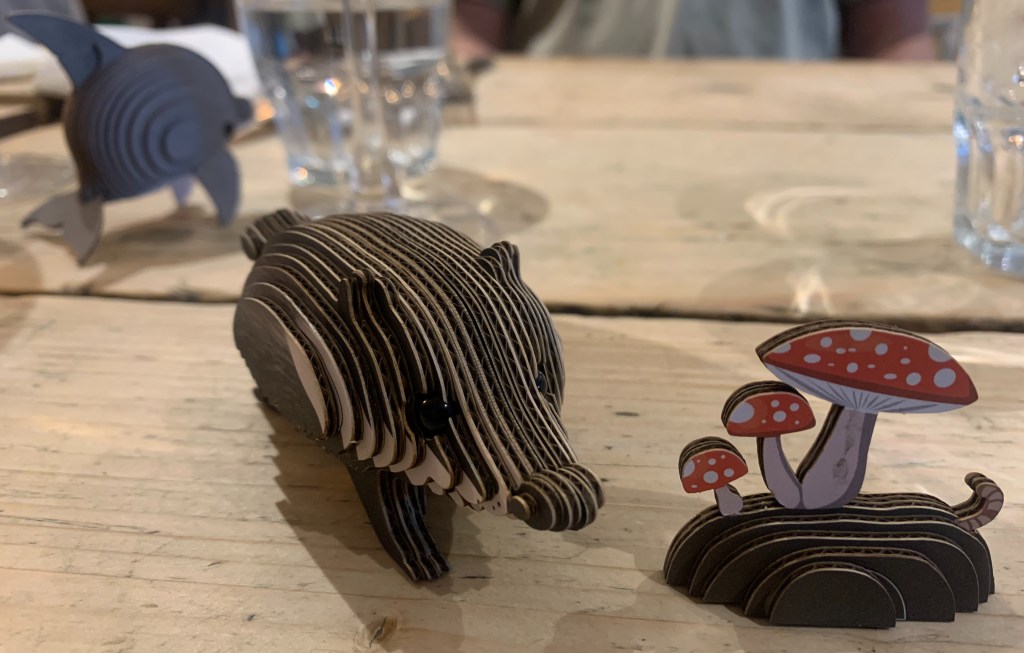
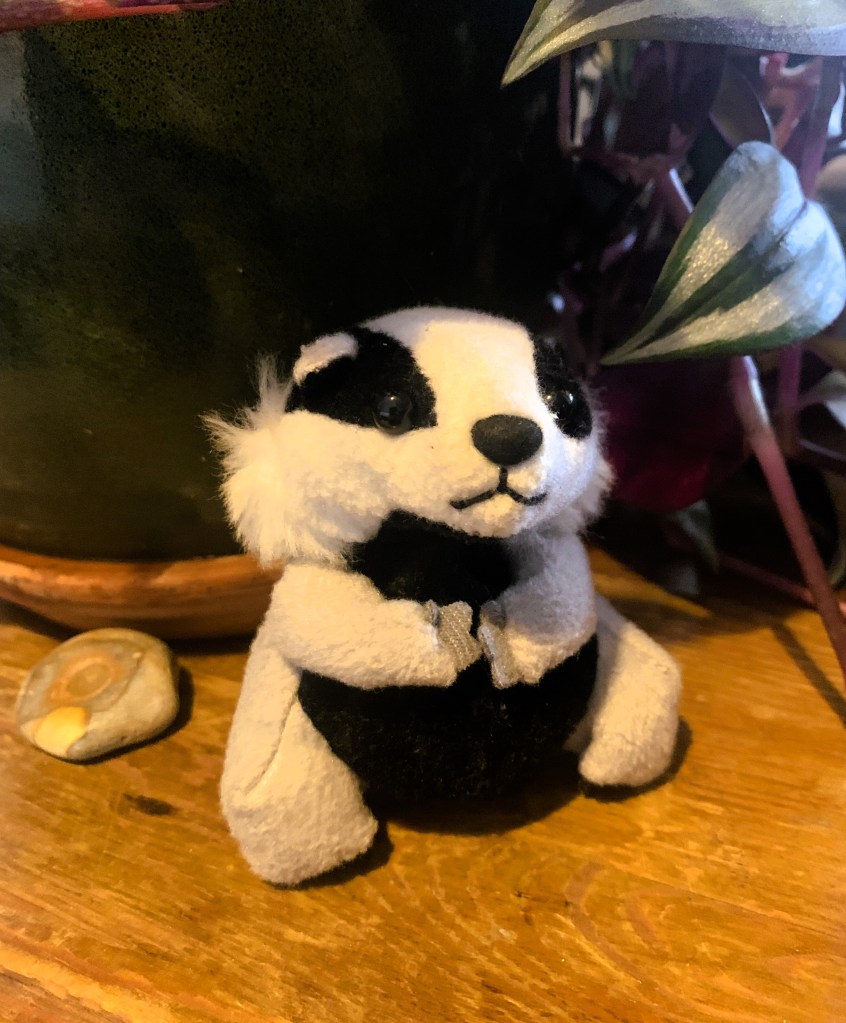
‘Badger comes across gruffly. The energy here is not angry, however, but rather one of high expectations.’ (1) Not only does the badger keep me motivated to work (when I don’t have a boss to answer to), it also reminds me to carve out time for my personal pursuits. Badger is a storyteller (and wants to get really good at it!). Badgers dig for roots and herbs; revealing treasure in the earth. Very much in the here-and-now and ‘a creature of patience and fortitude’; my inner badger keeps me trudging along, snuffling amongst the mushrooms (like Mr Mushy, below), burrowing for inspiration in woodlands and forests and beaches and countryside near the sea. Searching for gold, or fossils. Alongside my ageing, ambling hound – who is on a very different search (for tennis balls), but checks in with me periodically as if to say, ‘how’s it going for you? Have you found what you’re looking for?’
‘Because of their rare ability to create cross-species relationships, badgers are also symbols of friendship.’ (2)
I had a friend at secondary school who was also slightly obsessed with badgers. She often exclaimed, ‘That’s the badger!’ – meaning she’d found something she was looking for, or I had clarified something she’d said, or as an acknowledgement of a friend expressing something very genuine. Badger’s are adaptable to various terrains and environments, and known for eating rotting fruit, which causes them to become intoxicated; a badger-like friend is a great drinking buddy. They can also bring attention to imbalance; in nature, in relationships, in work or sense of security. An important lesson I’m learning – with the help of the persistent presence of the badger – is that if I dig (into work, into trauma, into grief) too much, too far, for too long – I lose my friends… and my family relationships suffer too. As do my inner relationships; the balance of my inner system.
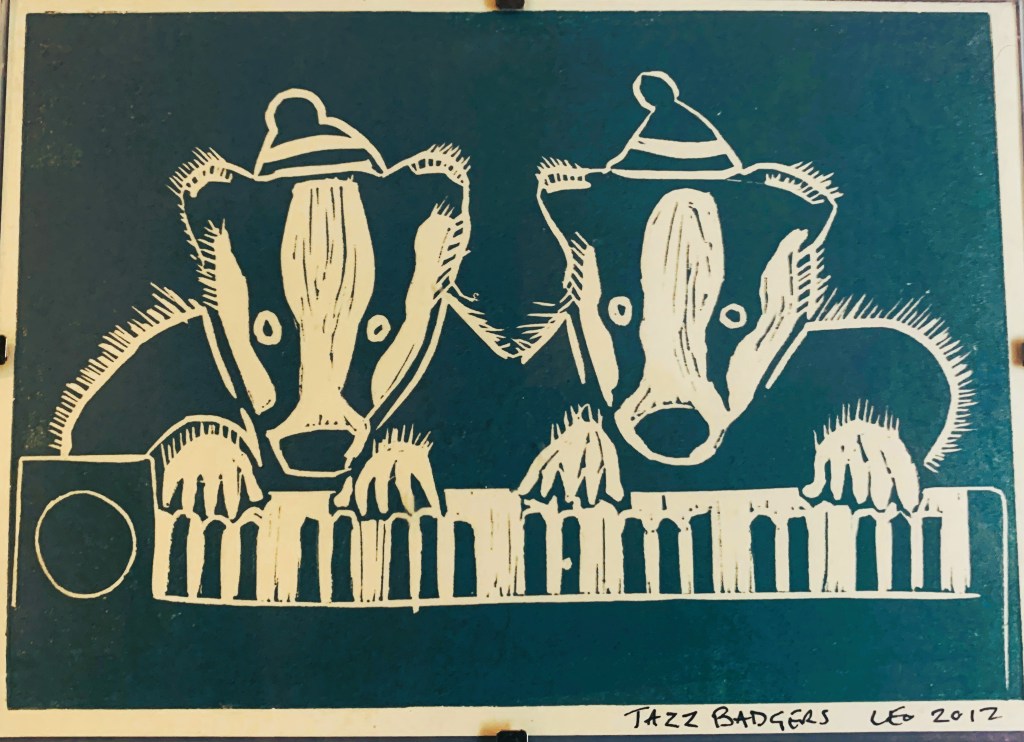
This year I discovered that in Al-Anon (3), one of the popular mantras is, ‘Look, but don’t stare’. This, I understand, relates to ones own distressing past experiences. Or, I suppose, those that other people are telling you about from their own pasts. I have a very visual mind (and a very vivid imagination): When somebody tells me something they have experienced, if I don’t catch myself, I immediately imagine it. I would like to extend the Al-Anon mantra to; ‘witness, don’t imagine’. Sometimes empathy can go too far, and be misguided. The jazz badgers (below) remind me to be alongside people without disappearing into their traumas, or my imagined versions of them.
Adventuring around my own imagined stories though, those are the journeys the badger really wants to get its teeth into. It wants to jump on a bus with no particular destination. There is so much more to experience, so much more to say, so much more to write…
‘If you have been laying low for a while, Badger’s appearance tells you it’s ok to come out now. Take your place in the spotlight. Don’t be shy – just go for it.’ (1)
My Dad once wanted to conquer the waves. He was very strong, possibly the strongest person I’ve ever known. Perhaps this was his burden to carry… until he couldn’t any longer. He fought cancer for over 10 years. He’s not coming back to life this time. I’m sure that’s hard for us all (his family and friends) to accept, in many ways, even though we wouldn’t wish his pain to continue any longer. I hope he was finally ready to go, and I wonder if he was waiting for us to be ready to let him go, although how could we really be ready for that?
At this point when I was jotting down these thoughts last week, a bird shat on my phone, from the tree I was standing under. And I swore at the bird… but then I thought, yeah, maybe you’re right and I am just talking shit! Anyhow. My Dad loved birds and I know that watching them on the bird feeders was one of his comforts during his long illness. My daughter made a hummingbird sun-catcher on St. Patrick’s Day, with her birthday craft set from her ‘Papi’. We’ll hang it in the window when we get home, for the sun to shine through and send colours around the room, reminding us of all the happy times we’ve shared together (with family), in Hull (Massachusetts), Hingham, Vermont, Colorado, Italy, Province-Town… and the multiple Thanksgiving-Christmasses with family and friends in the UK. And before that, my brother and I had many memorable and cherished times with our Dad in the Herefordshire countryside, at our childhood farm.
So, he was a farmer before he was a businessman, sailor, cowboy, cactus enthusiast, cigar collector, wine connoisseur… (what am I forgetting?). The memory of him being a farmer is kind of hazy and mystical – I just about remember him in his wellies, taking me out to the barn, on a snowy Christmas morning, to see a new born calf. (My Mum was the farmer really though!). I heard that as a child, he wanted to be a vet, often finding injured animals to nurse back to health. He was a lot of things, wore a lot of different hats. What I loved most though, was when he was just being Dad – hanging out, sharing a meal, watching movies together. The only thing I’m grateful for about his long illness, is that we got to hang out and watch a lot of movies!
Over the last few, more difficult years, my wonderful sister-in-law has been a huge support to me, and I know to my brother too. Thank you. And thank you (to my Stepmother) for being by his side, for so many years, so many long nights. I am so grateful too, for my father’s generosity, and his open, non-pressurising encouragement, of whatever I wanted to do. Both of which have opened many doors for me, literally and figuratively.
But what I was getting at before, was, that I need to let him go now. I’ve missed him all my life, as he’s often been away… or there has been an ocean in the way. And although I want him to feel powerful and free again – on the open ocean, or galloping on a horse over the Rocky Mountains – I also like to imagine that he’s crossing the water to come and see us, one last time, to enjoy the British spring with us, before passing through to go off on some new, wild adventure.
So I’ve chosen this short poem to finish, by Billy Collins (3);
Walking Across the Atlantic
I wait for the holiday crowd to clear the beach
before stepping onto the first wave.

Soon I am walking across the Atlantic
thinking about Spain,
checking for whales, waterspouts.

I feel the water holding up my shifting weight.
Tonight I will sleep on its rocking surface.

But for now I try to imagine what
this must look like to the fish below,
the bottoms of my feet appearing, disappearing.
T.S. Eliot, from “Little Gidding,” Four Quartets (Gardners Books; Main edition, April 30, 2001) Originally published 1943.
Collins, B. (2002) ‘Walking Across the Atlantic’, from The Apple That Astonished Paris(1988), in Sailing Alone Around the Room: New and Selected Poems, Random House Trade Paperback, New York.
This could have been called ‘Following the Shards of Light’. I deliberated over this for a long time. Shard implies sharp, a fragment, brittle, broken, dangerous (maybe), a weapon. Remnants of demolition – or war – or a bar fight. It is also a building in London of course. Not really the angle I was going for, but in the background nonetheless. How fortunate to have violence or war in the background rather than on the doorstep. Yet it affects us deeply, whether we want it to or not.
And what does shaft mean anyway? An NYPD detective from 1989? (Bear with me). It depends in what context, I realise.
The shaft of a feather, for example; ‘The long, slender central part of the feather that holds the vanes. It’s like the mast that holds the sails.’ (1)
Or, ‘a long, narrow, typically vertical hole that gives access to a mine, accommodates a lift in a building, or provides ventilation.’ (2) This reminds me of my brother doing a very convincing imitation of “What’s that Skip, the kids have fallen down the old mine shaft?” (3)
Quite a jumpy and haltering start to this season’s post. Fleetingly this came to mind – shaft, as in, male genitals. Again, not the direction I was intending to take. Finally, I resisted the distractions and focused in on this; a ‘beam’ or ‘ray’ of light, which is more what I was getting at. So in this case, shaft has to accompany sunshine for its meaning to work in the context of what I am writing about – attempting to anyway.
Now the procrastination is out the way…
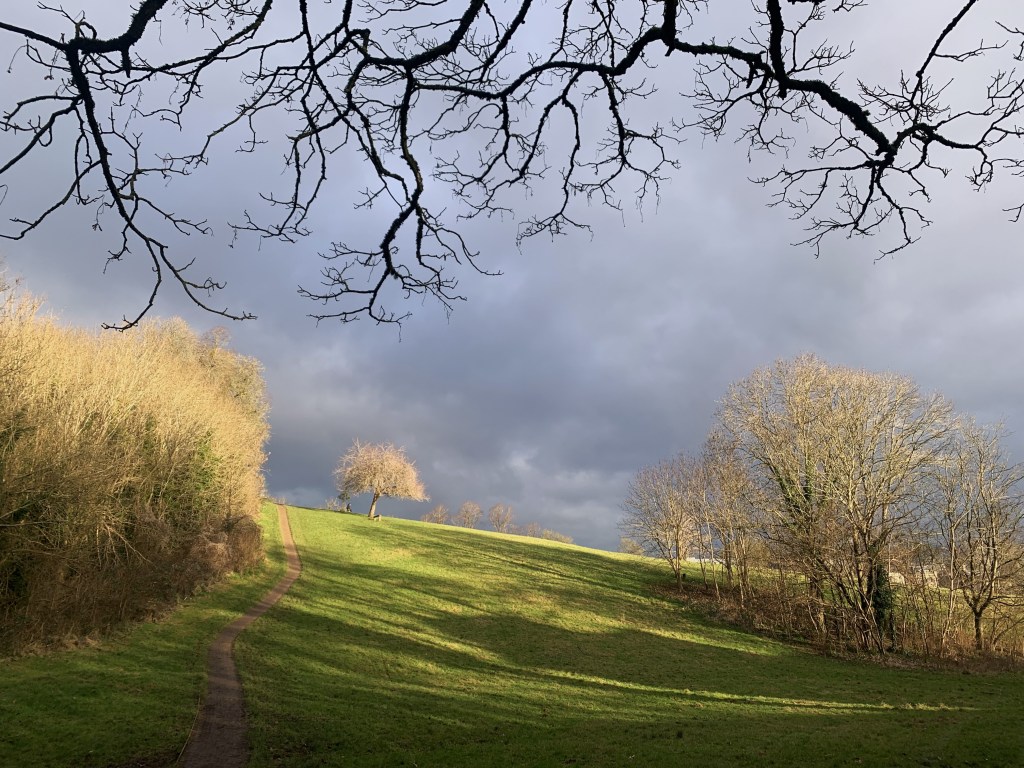
In early January, I enjoyed walking in the sunshine, with my dog of course. It didn’t take long for the options of sun on the ground to diminish and become sparse – much to my disappointment after our predominantly grey and rainy December in the UK. Stripy shards of light appeared between the trees and I was compelled to walk along as many of them as I could, to stay in the sun (and out of the shadow) for as long as possible, even if it meant clambering through a holly bush. Ouch! Nomar was oblivious to my quest, effortlessly weaving around the trees and bushes, in and out of light and shadow; his tail taking on a rapid figure of eight motion, as if it might propel him into the sky.
This Christmas just passed, relationships with relations felt fractured beyond my imagining. Shards of family. Or have we all simply stopped trying so hard to patch up the cracks? A façade of togetherness on both sides of my divorced childhood ‘family’, has existed for longer, further back, than I was able to acknowledge until mid-adulthood. Yet the attempts at unity persisted. Two separate togethernesses (I know, it’s not even a word!). Year after year after year.
Now that these attempts feel sluggishly irresolute, due to protracted terminal illness, infidelity, mental illness, neurodiversity and other barriers to effective communication – the threads wearing thinner and thinner and more frayed – I wonder what purpose and value they had before, and why they felt so important. I am in new territory, new tracks to be trodden – attempting to find my own way. I am an adult, have been for a while now, with my own small family unit; desperate for this to feel enough. And for me to feel ‘good enough’ (e.g. Winnicott; 4) for it.
I wrote about making new tracks many years ago when I first started ‘Psychodography’. An analogy to consciously working on new neural pathways in the brain… new habits, new conversations with Self and others, uncovering and acknowledging. I was referring to clients I worked with as a trainee Counsellor; people who were deep into major transitions in their lives – finally getting support for addiction, and by default, for the traumas which had led to the addictions and the further traumas caused by them. This struck me as immensely brave and worthy of the utmost respect. Digging into and exposing their hidden traumas and losses without the soothing, masking substance(s) or compulsion which had kept them going, and harmed them and their relationships of course, for most of their lives thus far.
‘We can hardly bear to look. The shadow may carry the best of the life we have not lived. Go into the basement, the attic, the refuse bin. Find gold there. Find an animal who has not been fed or watered. It is you!! This neglected, exiled animal, hungry for attention, is a part of your self.’
(Marion Woodman; 5)
There have been big endings and losses for me this month – the old painter I mentioned last time – and others. New beginnings and transitions too… and the usual things remaining the same; piles of laundry, running late for the school run, not knowing what to make for dinner. The combinations of usual and unusual, predictable and surprising; bringing both comfort and trepidation; mundanity and solace; nostalgia and giddy excitement.
These esoteric contrasts reflect in the magical qualities of winter, which are always there if you look for them. The long nights speckled with flurries of soft snow. Shimmering… in the moonlight. Frost and moss. A pair of pigeons snuggling into the ivy clad tree, while pale clouds race overhead. Eerie bright light framed by a moody grey sky, the very tips of the budding trees almost glowing luminescently.
The mystery feather which appears in the most unlikely place.
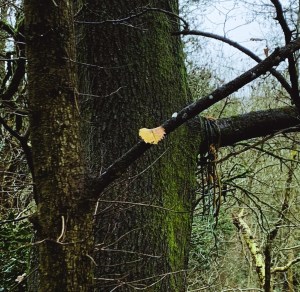
A single golden leaf yet to depart from its familiar branch.
Procrastination, as mentioned earlier, can be considered a reaction to grief and trauma. There’s so much on the internet about this, I managed to go down several worm holes and crawl out having not been able to make decision about which one to include here. It doesn’t matter. I’m not going to find what I need there. What I need is in the woods, the meadows, the streets, the friendly hellos with fellow dog walkers, sensations in my body, images in the mind’s eye, the childrens’ laughs, the people I meet through my work whom I would otherwise never meet, the space between us in the therapy room, the candle before bed.