As a child I wrote a lot of stories. I don’t know where they are now – I think they got lost in the mess of parental divorce and multiple house moves. I think I got lost too.
In therapy and on dog walks and with writing (hour by hour, week by week, walk by walk, page by page) I have been finding the pieces of myself and inviting them to come back together again. Digging out the old stories… not physically finding the originals written on paper, inscribed into primary school exercise books… but locating the ones in my memories, the ones etched into my body and senses; liberated, a little more, every time I plod the perimeter of a field or meadow, pause to pay attention to birdsong, breathe in the dewy moss. Stop – sit – close my eyes and welcome in the images of the past… and ask what they’re trying to tell me…
One story in particular sticks out in my memory, it probably went a little something like this:
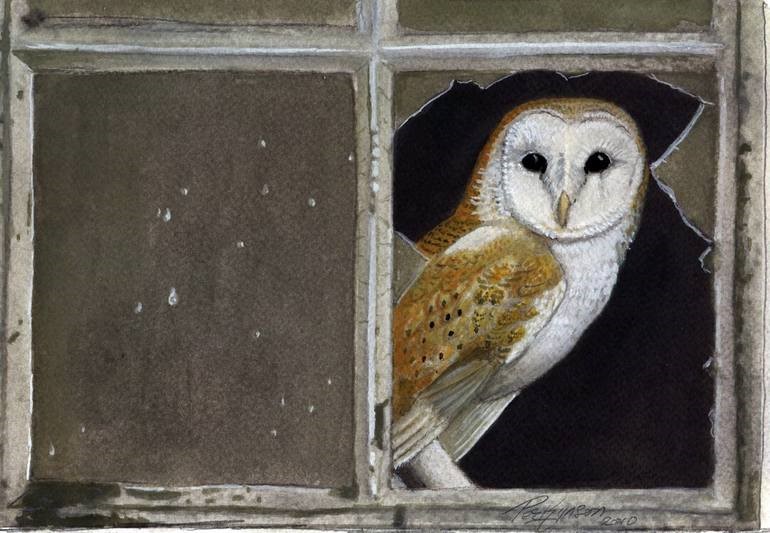
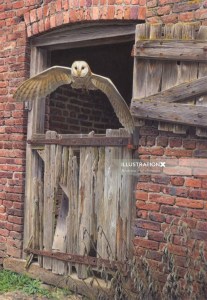
Once upon a time...there was an old painting of a farmhouse and a barn owl. This painting was in a cottage, where a little girl lived. She would walk past the painting, which was hung in the hallway, and would stop to gaze at it every day. She began to notice that each year, as she grew older, the owl would also look older and would move to different positions in the painting. At first, the owl was in a cherry tree next to the farmhouse, then the next year it had moved to thegatepost, thenit sat on the stable door, then perched on the edge of the wheelbarrow. The girl grew bigger, and older, each year, moving through her childhood, and the owl moved with her. In her eleventh year, the girl became gravely ill. She insisted on struggling down the stairs each day to see the painting, her mother and grandmother either side of her, holding each arm. The owl moved from the roof of the farmhouse, to inside, peering out through an upstairs window, looking extremely old. Eventually, the girl was no longer able to leave her bedroom. Her family were very worried, and feared the worst. They sat by her bedside every day. After she turned twelve, the girl became fretful and strained to speak. Her mother could only just make out the words, "The owl, where is the owl?" With her last breath, she murmured, "The owl in the picture". In her grief, her mother forgot all about the painting and the owl, until they were moving house and packing up the belongings. She stood in the hallway in front of the painting, about to take it down, but paused and stared into it. The owl had vanished completely.
‘We trust the page as a source of authority’, Clare Murphy says. While I tried to tell the owl story, I realised, with regret, that I couldn’t remember it very well at all. I am sure, therefore, that I have omitted and elaborated, rather a lot. I don’t remember, really, if the girl died, but I imagine there was a death of some kind, in this one of my many ‘morbid’ stories. There usually was. Stories help us to know ourselves and where we have come from; historically, personally and spiritually. We can grow through stories – telling and listening and sharing – and it helps me to not stick rigidly to the script, as I once did.
I wonder if anyone would want to listen to me tell my stories from the farm, what I remember of them, and what has been embellished. I have been stubbornly, guardedly, dependent on pen and page for as long as I can remember – keeping it all to myself, for the most part (except for the odd teacher, oh and letters to childhood ‘pen pals’ – I nearly forgot). Secret or not, writing has been a lifeline for me. Then I discovered relational risk-taking. The existence of an academic term for this, somehow gives me permission to take those vulnerable, exposing risks in relationships. Some, relationships.
Thanks to my ever present and trusting therapist, in recent years I have gained the confidence to read my writing out loud, to another, live, human person! I have a voice, and now I share it. Healing and healing and healing… from experiences that rendered me voiceless, powerless. I feel I am learning to talk, all over again, and learning to really, truly, listen. Learning to speak the truth about loss, and love. Learning to listen to those who I feel have taken up too much space in my mind, and tentatively trying to speak truthfully, to them. Learning to share experiences of living in Wales, and in the borderlands between Wales and England, with those I feel judged by; bridging generational and cultural gaps. I have important stories to tell, and so do they.
Vocal steps are being taken, small vociferous risks, gaining in strength and volume, pacing steadily up a mountain with each exhale, with every story, with every stride. To one day SHOUT from the top. A primal scream. Echoing through the valleys and caves. Meanwhile, recognising the safe and gentle places, spaces, people… when they appear – offer sanctuary – and learning to meet them in kind.
In some cultures, the stories tend to remain largely unchanged by the master storytellers and their apprentices, for example, in the ancient art of Rakugo in Japan, although apparently this is changing. Native American culture is also known for its rich oral tradition. ‘Each time a story is told, it breathes life into the culture… Their symbiotic connection to the earth and intimate relationships with the animals they depended on is also depicted through storytelling… often forcibly relocated to land that was not their own. Their customs, language and religion were ways for them to remain connected to each other and their homeland’; https://allgoodtales.com/storytelling-traditions-across-the-world-native-american/
I imagine families and communities from long ago, huddled around a fire telling stories. This is coming back, so I’m told, and plays a crucial part in the attempts to protect our natural world and our relationships with it and within it. I’m familiar with the Celtic storytelling traditions, although only just consciously recognising their value. I am also very drawn to Icelandic storytelling, with its ‘hidden people’ (do I actually remember ‘talking to fairies’ under the willow tree as a young child?). I visited Iceland towards the end of the pandemic, and experienced a profound connectedness there, as well as a powerful release of grief.
It is the end of winter in the UK, and finally it’s not so dark or cold! Though I’m sure the Icelanders would have something to say about me moaning over a ‘long’ winter.
Picture Icelanders living in turf longhouses sitting around smoky fire pits sharing stories and reading aloud to one another. Ancient myths, heroic quests, tragedies, comedies and lessons in life were all depicted in their traditional stories to keep spirits high… The stories of antiquity are allegorical accounts that teach their audience to respect both the spirits of the land, and the natural environment in which they reside…
A picture of course, can say a thousand words. But I’m no artist, so I’m sticking with the writing, and working on the speaking, and changing the script. And what if I change the owl story again, or write different versions of it? Alternative endings? I can do that, if I want to, it’s my story. What if the girl lives? A new, miracle, treatment is discovered! Nevertheless, the girl would have gone through a metamorphic experience – survived a terrible illness – been ‘at the edge of the everyday world’ (https://arnolfini.org.uk/whatson/previewrinkokawauchi/) and come back, changed, a tacit transformation, like the start of spring (which always takes me by surprise).
Maybe she would want to leave the farmhouse, perhaps live in a tall townhouse on the edge of a cosmopolitan city. She wouldn’t see barn owls anymore… or perhaps would – she could visit Granny in the countryside, even go to an owl sanctuary together! And what of the owl in the picture… would it disappear anyway?

 Psychodography